Pages

Sunday, April 24, 2011

Jesus Lives

Jesus lives, and so shall I.
Death! thy sting is gone forever!
He who deigned for me to die,
Lives, the bands of death to sever.
He shall raise me from the dust:
Jesus is my Hope and Trust.

Jesus lives, and reigns supreme,
And, his kingdom still remaining,
I shall also be with him,
Ever living, ever reigning.
God has promised: be it must:
Jesus is my Hope and Trust.

Jesus lives, and by his grace,
Vict'ry o'er my passions giving,
I will cleanse my heart and ways,
Ever to his glory living.
Me he raises from the dust.
Jesus is my Hope and Trust.

Jesus lives, I know full well
Nought from him my heart can sever,
Life nor death nor powers of hell,
Joy nor grief, hence forth forever.
None of all his saints is lost;
Jesus is my Hope and Trust.

Jesus lives, and death is now
But my entrance into glory.
Courage, then, my soul, for thou
Hast a crown of life before thee;
Thou shalt find thy hopes were just;
Jesus is the Christian's Trust.

Thursday, April 21, 2011

2764 Years

After completely embarrassing myself in excitement at the museum yesterday upon finding an ancient Roman wood panel painting (Yeah, slightly obsessed....actually, not even that. I'm gone all the way.), I might as well do it again today:

HAPPY BIRTHDAY ROME!!!!

"I hope my passion for Rome's past has not impaired my judgment; for I do honestly believe that no country has ever been greater or purer than ours or richer in good citizens and noble deeds...."
Livy

Tuesday, April 12, 2011

Spurgeon hits the nail right on the head

"There is no attribute more comforting to His children than that of God's sovereignty. Under the most adverse circumstances, in the most severe trials, they believe that Sovereignty has ordained their afflictions, that Sovereignty overrules them, and that Sovereignty will sanctify them all. There is nothing for which the children ought more earnestly to contend than the doctrine of their Master over all creation - the Kingship of God over all the works of His own hands - the Throne of God and His right to sit upon that Throne.
"On the other hand, there is no doctrine more hated by worldlings, no truth of which they have made such a football, as the great, stupendous, but yet most certain doctrine of the Sovereignty of the infinite Jehovah. Men will allow God to be everywhere except on His throne. They will allow Him to be in His workshop to fashion worlds and make stars. They will allow Him to be in His almonry to dispense His alms and bestow His bounties. They will allow Him to sustain the earth and bear up the pillars thereof, or light the lamps of heaven, or rule the waves of the ever-moving ocean; but when God ascends His throne, His creatures then gnash their teeth. And we proclaim an enthroned God, and His right to do as He wills with His own, to dispose of His creatures as He thinks well, without consulting them in the matter; then it is that we are hissed and execrated, and then it is that men turn a deaf ear to us, for God on His throne is not the God they love. But it is God upon the throne that we love to preach. It is God upon His throne that we trust." (quoted in The Attributes of God by A.W. Pink)

Sunday, April 10, 2011

Another Sunday blurb

One of the reasons why I love my pastor's sermons is that they inevitably get me thinking. Ok, so not always is it something that has directly to do with the topic, but it's always related. Anyways, lately we've been in the Upper Room Discourse, and the apostle Peter's been coming up. It hit me that I've always looked at him sort of as two different people. 

First, there's the Foot-in-Mouth Peter who unfailingly comes up with brilliant statements like this one during the Transfiguration: 
"Lord, it is good for us to be here; if You wish, I will make three tabernacles here, one for You, and one for Moses, and one for Elijah."
Then there's the Peter of Acts 2 who gives a stunning sermon ex tempore at Pentecost and goes on to write a couple books in the New Testament.

But what I find rather fascinating is the amount of time that elapses between these two different personalities: 50 days. There are only 7 weeks between Peter's denial of Christ to his sermon about Him in Acts 2. That's quite a transformation in such a short amount of time.

So of course it set me thinking, how could that happen? And then I arrived at the obvious conclusion - it was the Holy Spirit. I find that encouraging, because even though you don't see that kind of dramatic change happen too often anymore, it shows that if God can do that kind of a work in someone, He can help me in the tiniest problems I have. Which now brings me back to what the sermon today was really about - if we want to progress in sanctification, we need to rely on Christ.

Sunday, March 27, 2011

Christ's death

As I was listening to my pastor's sermon this morning, something about Christ's death hit me. We all know of the classic Who Killed Christ? debates that went on (and still happen) through the centuries. Some point the finger at the Jews, citing all the passages where the Pharisees/Sanhedrin plotted His murder. Their opponents stand behind the fact that Pontius Pilate took the official charge of overseeing His torture and crucifixion. Well, both sides are right. And what I found interesting about that is its theological connection. God's causing both the Jews AND the Gentiles to be responsible for Christ's death highlights the universality of man's guilt. (Romans 3:23) Who knows what kind of weird heresies would have turned up had the Jews dealt with it amongst themselves, or vice-versa? (I can just see another "Pos" debate, this time concerning the Great Commission - "All means all except when we're talking about the race of people who killed Jesus....." {Now wouldn't that be quite the dilemma, considering Christians are the true ones responsible for Christ's death.}) All in all, it makes me appreciate the sovereignty of God even more.

Friday, March 25, 2011

On the evils of ammonia

Today, we met with some friends for a weekly science/speech/home ec. co-op. The three of us who are in chemistry do the experiments at the library, and this week we needed ammonia, which one of us brought, and then forgot to take home. ;-) Being the stunningly nice people that we are, we took it with us when we left. 

Now it is important to mention here that, as there wasn't any lid, the cover of the jug-o-ammonia has to be covered with tin foil. So, when we were turning into the Culvers parking lot to get some dinner (yeah, we're real classy), what do you know! the ammonia spilled. After the assorted shrieks and exclamations that followed, mom pulled into an obscure parking spot and rushed off to rinse out the carpet which had been hit, while I guarded the jug which had now been banished to sit on the piece of ice we parked on. So ignoring the cold of the ice coming through my thin shoes (so Oliver Twist-esque) and how awkward I must have looked - a random teen standing in a parking lot with a jug of a major ingredient in meth - I waited for mom to come back. She finally did, and we deemed waiting in line while inhaling the fumes not worth the brain damage, so we headed home. 

So while mom drove, I held the jug with my feet while avoiding the fumes by hanging my head out the window, sort of like a dog. (In 30 degree weather) Here, I was faced with a decision. I read on a blog a while back that, when in an irritating situation, you can either laugh or cry. Being more of a fan of the former, I started laughing......and laughing..... (Those fumes were getting strong there....) We eventually got home, evacuated the car, and consigned the ammonia to its fate on our front porch, where it is sitting now.

So there was really no point in writing this post, except that I found it entertaining and love the piece of advice I mentioned in the preceding paragraph. And to warn you against the evils of  traveling with ammonia, I guess.

Miscellanies # 3

My friend gave me this shirt a couple weeks ago. Is this not the greatest ever?


With all this drama in Libya, I'm seeing some posts on Facebook by people who are adamantly against America's getting involved, mentioning Bush's invasion of Iraq. It has me thinking. I'm not for our getting ourselves in the middle of every little skirmish that occurs around the world, but I definitely do not support Isolationism. I can't help but wonder whether WW2 would have ended differently - and many lives have been saved - if FDR hadn't waited so long to get involved.  Yeah, I'm not a fan of America meddling in everybody's business, but if we could prevent another Hitler or Stalin, might it worth it to get involved SOMETIMES?

It seems like all the Christian Blogosphere has been talking about in the past few weeks is Rob Bell's new book. I'm surprised that everybody's surprised. I mean, wouldn't you EXPECT a leader of the Emergent group to be a universalist? I'm just finding it to be incredibly underwhelming.

As Sense and Sensibility is my favorite book, I am so doing this.


I love this first question/answer of the Heidelberg Catechism:

Q. What is your only comfort in life and death?
A. That I am not my own,
but belong-
body and soul,
in life and in death,
to my faithful Savior Jesus Christ.

Tuesday, March 22, 2011

Odyssey - books 1 & 2


As I was about to open my edition and start reading Book 1, I wondered to myself whether it was because of a nerdy 7th grade whim that the Odyssey was on my list of favorite books. But as soon as I read the first line, AH, everything that I love about this book came back to me. How could I have been so faithless? ;-)

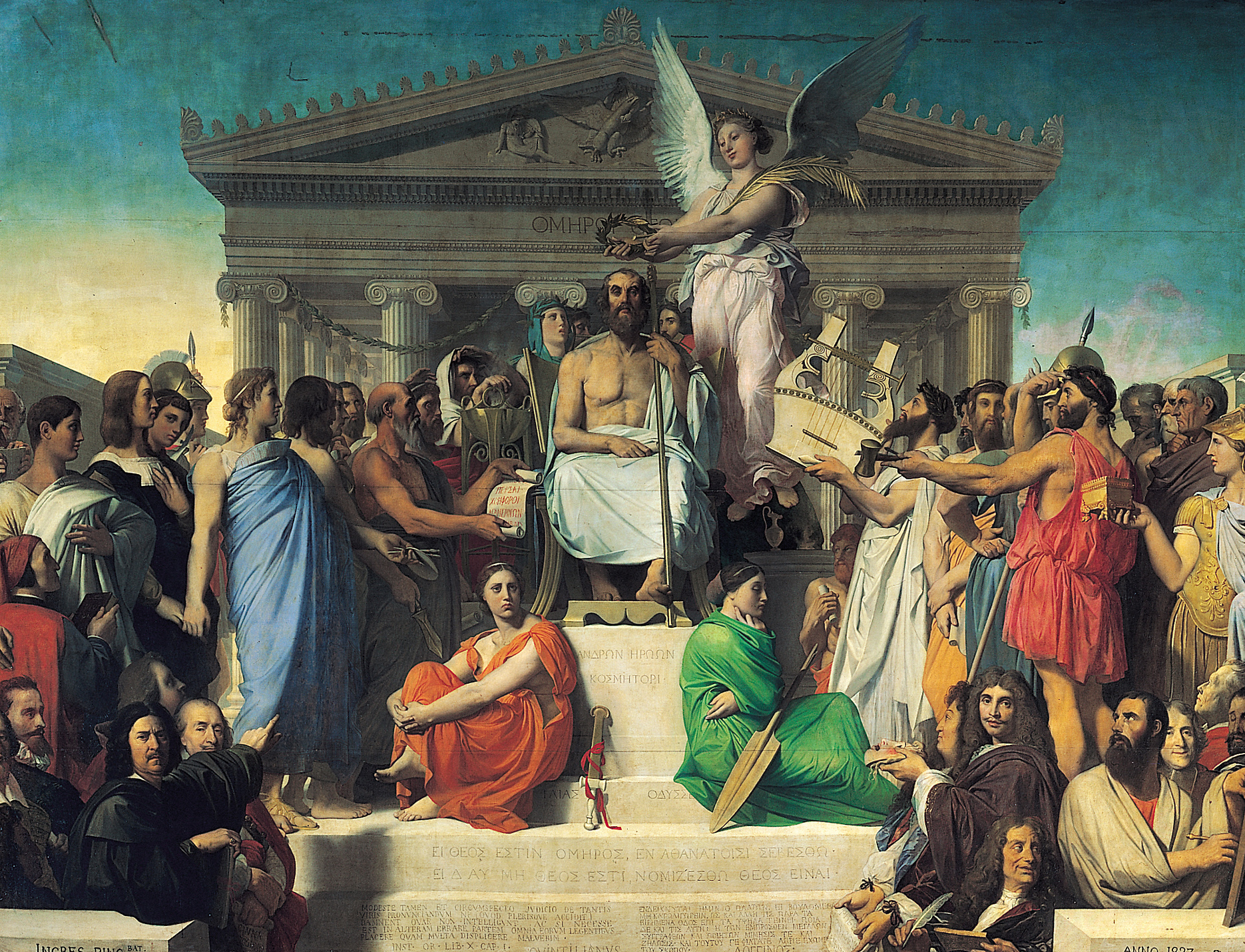
Not cool with idolatry, but I understand why people paint pictures like this. Homer, you are so brilliant.
So we all know the story. The Trojan War has ended, and all the surviving Greek warriors have made their way home, except one. Enter hero Odysseus. The Odyssey opens 9 years after the end of the war, with the king of Ithaca nowhere in sight. Instead, his palace is overrun with cocky suitors vying for his wife, Penelope. His son, Telemachus, has arrived at adulthood and is thoroughly fed up with the aforesaid leeches. Apparently it's taken 9 years to get the oh-so-dynamic set of Olympian gods to notice all that trouble going on in Odysseus's family. So Athena steps in and takes charge of the situation, appearing to Telemachus and persuading him to sail to a neighboring city to search for any news of his father.

One of the things I love about Homer's poetry is how each character is named. Probably for the sake of meter, Homer always attaches an adjective to the person he's writing about. So, for instance, instead of boring old prosaic "Odysseus," we have "resourceful Odysseus." Get what I mean?  It sort of gives the narrative parts a little pizazz. My personal favorite is "rosy-fingered Dawn." I don't know why I get so much of a kick out of this.

This time around, I've already found two "themes" in the Odyssey to think about.
  1. Greek mythology v. the True God. Reading the first two books today, I was struck with just how futile the members of the former are. They're pretty much just immortal humans with superpowers. They spend their days doing nothing really productive, unless you call carousing or messing up mortals' lives for entertainment a good use of time. It makes me think of Elijah's taunt to the Baal worshipers in 1 Kings 18:
    "It came about at noon, that Elijah mocked them and said, "Call out with a loud voice, for he is a god; either he is occupied or gone aside, or is on a journey, or perhaps he is asleep and needs to be awakened." So they cried with a loud voice and cut themselves according to their custom with swords and lances until the blood gushed out on them. When midday was past, they raved until the time of the offering of the evening sacrifice; but there was no voice, no one answered, and no one paid attention."
    I am so glad our God is one who cares about his people.
  2. The family of Agamemnon. Don't let that weird looking name scare you. He's Helen of Troy's brother-in-law. This was quite the dysfunctional family. While he was gone fighting at Troy, his wife, Clytemnestra took a lover and the illicit pair decided to kill Agamemnon upon his arrival home. It all ended with their son killing Clytemnestra to avenge his father's death.

    I believe Homer mentions this family so much in the Odyssey to provide a parallel to that of Odysseus. Both families have a father returning home after a long war; both have a wife tempted to commit adultery; both have a son loyal to his father. Perhaps Homer is trying to set up some tension in the story - we, the readers, will be wondering the whole time whether Odysseus's family will end up in the same boat as that of Agamemnon's.
So, can you tell that I love this story yet? Until next week....

Monday, February 28, 2011

Traveling

Tomorrow, my sister and I are flying down to Florida to visit my aunt for a week. Not quite sure about everything the itinerary holds in store, but I do know that keywords such as "beach," "pool," and "Disney World" are involved. 

Excepting the unease I'm choosing to ignore which goes along with the idea of sitting in a chair 6 miles up in the sky for 2.5 hours, I'm looking forward to the trip. It's going to be really weird to go from 30 degrees in the morning to 75 in the evening. Oh the wonders of modern transportation.

I really like this picture...not sure why.
And it in no way relates to this post.

So anyways, no posts till the 8th. But I've had some ideas of things to write about, so maybe they'll turn up here when I get back. You were warned.

Oh, and today, I rediscovered this quote I had come across, and I liked it so much, I had to post it here: "Knowledge is proud that he has learned so much; wisdom is humble that he knows no more." (William Cowper) Is that not awesome?

Tuesday, February 15, 2011

Religious hypocrisy


"There are bogus men of God just as there are bogus men of courage. And in the same way as we see that when their honor is put to the test the men of courage are not the ones who make the most noise, so the truly pious men of God, in whose footsteps we should follow, are not those who put on the biggest show."

"....just as I believe that if there are still heroes none should be more respected than those who sincerely believe in God, and that nothing on earth is finer or more noble than the sacred fervor of true faith, I also think that there is nothing more odious than a brazen show of spurious piety by shameless hypocrites and self-advertising Pharisees who strike sacrilegious, two-faced attitudes and unrestrainedly exploit and freely mock everything humankind holds most holy and most sacred; people who, putting their own interest first, turn faith into a profession and a commodity and set out to buy credit and public honors by rolling their hypocritical eyes and faking zeal. I mean the ones you see displaying spectacular fervor and turning the path to heavenly salvation into the road to earthly fortune." 
Moliere, Tartuffe