Pages

Showing posts with label Junto. Show all posts

Tuesday, March 22, 2011

Odyssey - books 1 & 2


As I was about to open my edition and start reading Book 1, I wondered to myself whether it was because of a nerdy 7th grade whim that the Odyssey was on my list of favorite books. But as soon as I read the first line, AH, everything that I love about this book came back to me. How could I have been so faithless? ;-)
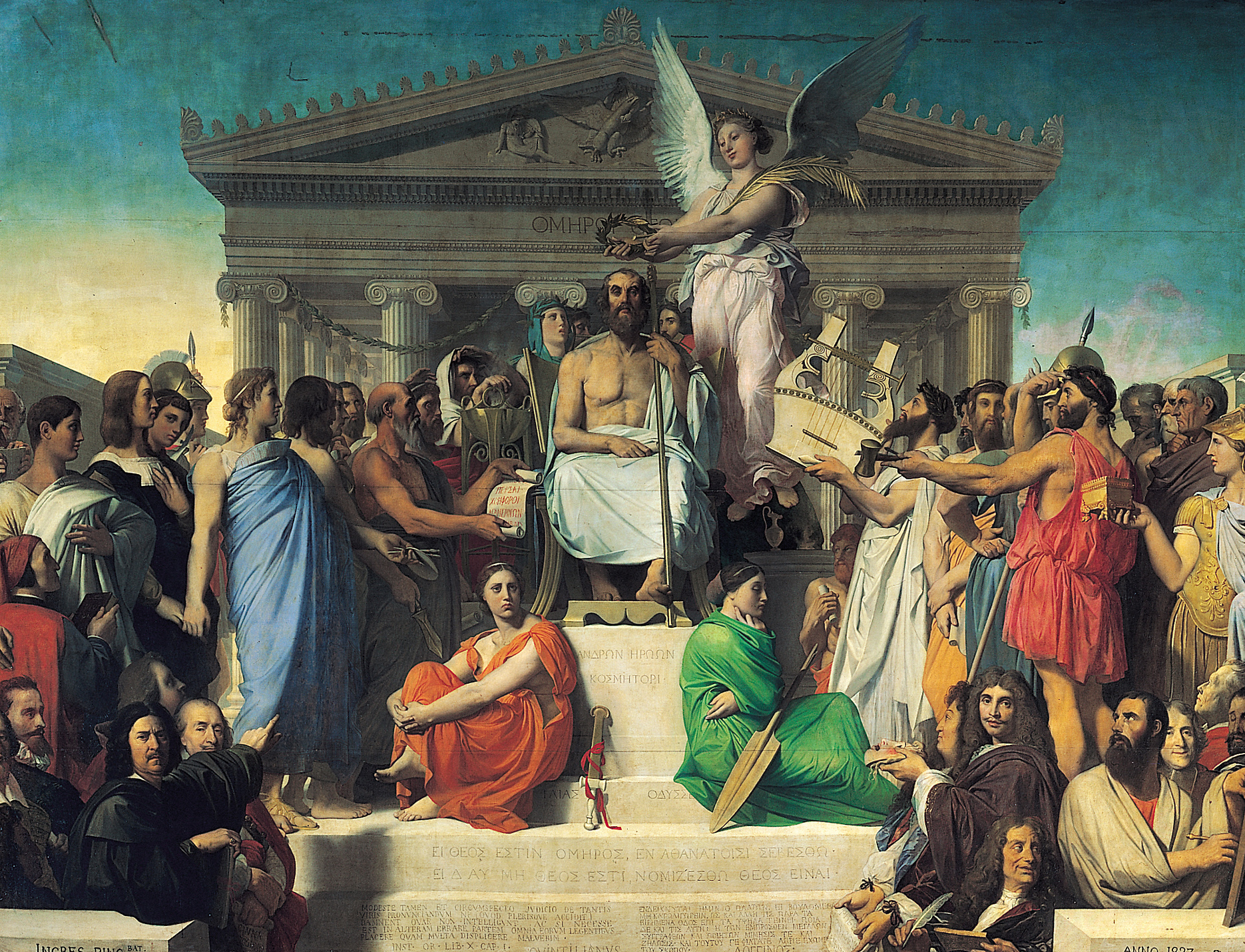
Not cool with idolatry, but I understand why people paint pictures like this. Homer, you are so brilliant.
So we all know the story. The Trojan War has ended, and all the surviving Greek warriors have made their way home, except one. Enter hero Odysseus. The Odyssey opens 9 years after the end of the war, with the king of Ithaca nowhere in sight. Instead, his palace is overrun with cocky suitors vying for his wife, Penelope. His son, Telemachus, has arrived at adulthood and is thoroughly fed up with the aforesaid leeches. Apparently it's taken 9 years to get the oh-so-dynamic set of Olympian gods to notice all that trouble going on in Odysseus's family. So Athena steps in and takes charge of the situation, appearing to Telemachus and persuading him to sail to a neighboring city to search for any news of his father.

One of the things I love about Homer's poetry is how each character is named. Probably for the sake of meter, Homer always attaches an adjective to the person he's writing about. So, for instance, instead of boring old prosaic "Odysseus," we have "resourceful Odysseus." Get what I mean?  It sort of gives the narrative parts a little pizazz. My personal favorite is "rosy-fingered Dawn." I don't know why I get so much of a kick out of this.

This time around, I've already found two "themes" in the Odyssey to think about.
  1. Greek mythology v. the True God. Reading the first two books today, I was struck with just how futile the members of the former are. They're pretty much just immortal humans with superpowers. They spend their days doing nothing really productive, unless you call carousing or messing up mortals' lives for entertainment a good use of time. It makes me think of Elijah's taunt to the Baal worshipers in 1 Kings 18:
    "It came about at noon, that Elijah mocked them and said, "Call out with a loud voice, for he is a god; either he is occupied or gone aside, or is on a journey, or perhaps he is asleep and needs to be awakened." So they cried with a loud voice and cut themselves according to their custom with swords and lances until the blood gushed out on them. When midday was past, they raved until the time of the offering of the evening sacrifice; but there was no voice, no one answered, and no one paid attention."
    I am so glad our God is one who cares about his people.
  2. The family of Agamemnon. Don't let that weird looking name scare you. He's Helen of Troy's brother-in-law. This was quite the dysfunctional family. While he was gone fighting at Troy, his wife, Clytemnestra took a lover and the illicit pair decided to kill Agamemnon upon his arrival home. It all ended with their son killing Clytemnestra to avenge his father's death.

    I believe Homer mentions this family so much in the Odyssey to provide a parallel to that of Odysseus. Both families have a father returning home after a long war; both have a wife tempted to commit adultery; both have a son loyal to his father. Perhaps Homer is trying to set up some tension in the story - we, the readers, will be wondering the whole time whether Odysseus's family will end up in the same boat as that of Agamemnon's.
So, can you tell that I love this story yet? Until next week....

Saturday, February 12, 2011

Miscellanies #2

Spring is coming.......
1. THE PACKERS WON THE SUPERBOWL!!!!!!!!!!!!!!!
2. Maddie & I are going to be reading the Odyssey soon for the Junto. Get ready for half-mad ravings of admiration for it in the weeks to follow.
3. I got this book the other week at the library for $0.25. Epic win.
4. Today, I finished reading Dante's Purgatory. Not as good as Inferno, but it was interesting to read because I've never really given the place much attention (probably because I don't believe it exists...ha). As is pointed out in the notes of my book, there's no fire until the end, which is odd because I always thought the traditional Catholic view is that the place is a sort of furnace that burns away your remaining sin. Huh. Anyways, I really enjoy watching how Dante chose to arrange the respective "destinations" - examining his reasoning behind the books is really thought-provoking.
5. I hate the lame attempts at philosophy the makers of Dove chocolates put on their wrappers. Apparently, they've gotten desperate and have turned to asking others to contribute their  homemade profundities. So this is what I saw the other day:

"The heart is more deceitful than all else
And is desperately sick;
Who can understand it?"
Jeremiah 17:9

Thursday, January 27, 2011

Wives and Daughters - the rest of the book

So I finally decided to write another Junto post. I do cruel things to myself, like attempting to read 15 books at once (do not try this at home), convinced the earth cannot revolve another day if I don't finish each one by the end of the month. Fine literature such as Wives and Daughters often gets put on the back burner in the inevitable book-reading crises that occur when the 28th or 29th rolls around. So that, my dear readers, is my meager apology for forgetting to write another Junto post.

I suppose I ought to summarize what happened in the book.......but 500 pages worth of plot is not going to fit neatly into 2 or 3 little paragraphs. I'll give you the ADHD version here, and if you think I left too much out, go read Wikipedia:
  • Mr Gibson gets married and his new wife is....ANNOYING. Molly and her new step-sister, Cynthia, become best friends. Cynthia is one of those memorable characters - charming but odd, worldly but impetuous, superficial but mysterious.
  • Molly & Osborne and Roger become virtual brothers and sister. Osborne disappoints his family by neglecting his studies and going into debt. Mrs. Hamley becomes very sick and eventually dies.
  • Roger becomes smitten with Cynthia and they get engaged. Roger travels to Africa for 2 years to do research and collect specimens. Molly finds out Osborne has secretly married a young Catholic Frenchwoman, who has just had a baby.
  • Cynthia tells Molly that she's been engaged to another man, and creates a scandal in town when she breaks it off. She feels guilty about the whole thing, and breaks off her engagement to Roger too.
  • Osborne dies suddenly from a heart problem, and his widow shows up at Hamley Hall. Mr. Hamley, despite his hatred of French and Catholics, accepts his daughter-in-law and grandson.
  • Roger comes back, and Cynthia marries somebody she met in London. Roger falls in love with Molly.
Molly, Roger, and Mr. Hamley
 Here follow some random observations on the book.

Wives and Daughters really reminded me of Mansfield Park. They both have a good-natured, naive heroine who likes a nice-guy hero who is too stupid to realize it because he likes a less than upright woman. The aforesaid heroine spends most of the book pining for the hero, lamenting the unworthiness of her rival, until finally, in the second or third-to-last chapter, the hero awakens to the wonderful-ness of the heroine. Maybe some people like this kind of story, but I find it frustrating and dull. The whole time, I just want to shake the guy and make him see how much of an idiot he is. Wives and Daughters isn't as bad as Mansfield Park, however, so I was able to get over it most of the time.

Although some aren't excessively fond of Osborne,  I couldn't help being sympathetic towards him. Yeah, most of his problems are his own fault, but if his father hadn't been so narrow-minded, many of them could have been resolved. But still, he ought to have been brave and face his father. Doing the right thing is always worth the pain that it may cause.

I also found it ironic yet realistic how Osborne, who had been the "genius" of the family, ended up being overshadowed by the younger and slightly under appreciated Roger. How often are we so focused on what we perceive to be the greatness of one thing/person, while completely ignoring the equal worth of another?

All in all, Wives and Daughters wasn't a brilliantly thought-provoking book, but it was fun to read. I saw the movie a few years back, (which, alas, spoiled the plot for me) so I want to see it again and decide whether it was faithful to the book. I'll let you know what I find out.

Thursday, January 6, 2011

Happy New Year

Christian in Palace Beautiful
If I were reading this, my mind would go on auto-pilot because of the title. A bunch of the blogs I read (and it's always the most interesting ones) have been half-forgotten by their owners, but upon the arrival of 2011, at least half have been updated with a Happy-New-Year!-Sorry-for-being-a-bad-blogger-It-won't-happen-ever-ever-again post. And then there isn't another post until February. C'est la vie.

I will join the band of absent-minded bloggers in saying that there are some things I want to change though. Here follows my Blogging New Years Resolutions:
  1. More book reviews. (Or at least to talk about what I'm reading) What's the point of reading if you can't share what you learn? Last year I made a goal to read 5 books a month, and am continuing it this year. And there's got to be SOMETHING interesting to write about in there.
  2. A revamping of the Junto. Let's all say it together: The Junto fails. Maddie and I have been talking a lot about it, and have decided to try a new approach. Instead of randomly choosing books that look entertaining, we have decided to follow a list. Actually a book - Invitation to the Classics. I'm really excited about it!
  3. Following through with what I plan to do here. Otherwise, I just look like an idiot......
I've pretty much given up on personal New Years resolutions. But I'll make an exception for this one of Jonathan Edwards: "Resolved, to strive to my utmost every week to be brought higher in religion, and to a higher exercise of grace, than I was the week before."

I hope your 2011 is a year grace-filled and God-centered.

Monday, November 29, 2010

Wives & Daughters - chapters 1-10

Sorry for not posting lately. We were really busy with Thanksgiving and such. If anybody still reads this blog, I hope you had a great Thanksgiving! Now, on with this post......


Honestly, I haven't really found too much in Wives and Daughters so far to make up an interesting blog post. Either Gaskell writes pure narrative or I'm bad at analyzing (probably the latter ;-). So sorry if this is a pretty boring first post.

The main character is a 17 year old girl named Molly Gibson, who is the daughter of a semi-brilliant country surgeon; her mother died when she was little. Not surprisingly, Molly & her father are pretty close. Although she has a sort of governess who lives with them, Molly lives in a slightly awkward position - two young interns live in the house to study under Dr. Gibson, and one of them seems to have acquired a fancy for Molly. After intercepting a love letter from the aforesaid smitten intern, Molly's father decides to send his daughter to visit friends for a while.
Molly becomes pretty close with Mr. & Mrs. Hamley, the people she's staying with. They always talk about their two college-age sons, who seem to be exact opposites of each other. The older son, Osborne, is polished, intellectual, and poetic (the family has high hopes for him), while Roger, the younger, is entirely uninterested in book learning, preferring all things natural and scientific. Roger comes home to visit for a while, and he and Molly don't really hit it off.

One day, Molly's father decides to get married again. The intended lady, a widow, has a daughter Molly's age, so you'd think the whole thing is a good idea. However, Mrs. Kirkpatrick sort of seems like a rather selfish, shallow person, and when Dr. Gibson informs Molly of the news, she freaks out. Later on, Roger finds her crying under a tree, and in a gruff sort of way, tries to console her. So I'm thinking that they'll probably become friends despite their initial personality clash.

Like Jane Austen's novels, there's a very clear distinction in Wives and Daughters between the "commoners" and the gentry. You know there will be the inevitable Rich-girl/guy-wants-to-marry-poor-guy/girl-but-snobby-parents-interfere situation. And I find it slightly not cool how suddenly Dr. Gibson decided to re-marry. Although he had been thinking about it for a while, he literally made the decision AND came up with who to marry all while riding over to a client's house. Yikes!

One thing about Victorian literature that always strikes me is the different and odd philosophies to be found in each book. (Alcott is one of the weirdest) Wives and Daughters is not excluded. Here's an excerpt in which Dr. Gibson tells Molly's governess how he would like her education to go:
"Don't teach Molly too much: she must sew, and read, and write, and do her sums; but I want to keep her a child, and if I find more learning desirable for her, I'll see about giving it to her myself. After all, I am not sure that reading or writing is necessary. Many a good woman gets married with only a cross instead of her name; it's rather a diluting of mother-wit, to my fancy; but, however we must yield to the prejudices of society, Miss Eyre, and so you may teach the child to read."
????

But besides these assorted oddities, I find Wives and Daughters to be a pretty good book so far. I like the everyday kind of story, not gothic novels a la Emily Bronte or Ann Radcliffe. The subtitle of Wives and Daughters is "An Everyday Story," so I think we're good to go.

Till next Monday....

Wednesday, October 27, 2010

Wives & Daughters

Elizabeth Gaskell in the year of her marriage
I was so into starting this, I sort of read the first 7 chapters. Oops. I promise to wait till next week to talk about them!

Like many of the famous authors of the 19th century, Gaskell originally published Wives and Daughters in a periodical. Cornhill Magazine was a competitor of Dickens's own All the Year Around, and its first editor was William Makepeace Thakeray of Vanity Fair fame.

I was looking at my edition of Wives and Daughters, and the author blurb said that Elizabeth Gaskell married a Unitarian pastor. In the 1800's novels were frowned upon by most pastors, so it would seem to be an odd match. But the Unitarians, whose outlook on religion was 'Everybody's right!', were more concerned with social issues than deciding whether novels were wholesome or not. I'm curious to see whether traces of Mrs. Gaskell's "theology" will show up in the book.

Also from the cover of my book, it appears as if Darwinism might make an appearance. One of the characters in Wives and Daughters is an avid naturalist, and Gaskell mentions one of his interests being comparative anatomy. If I remember what I learned in biology, comparative anatomy and Darwinism go hand in hand.

Apparently, Gaskell died before she finished the book, so I guess we all get to imagine how it ends. However, the second editor of Cornhill Magazine decided to finish it (presumably to keep the subscribers happy) and the last chapter is written by him. I wonder if he made it all up himself or whether Gaskell left behind notes that he followed? Hmmmmm......

Wednesday, October 13, 2010

October


  1. I said last week that we'd be starting Wives and Daughters on Monday, but Maddie is taking a break from blogging for a couple weeks, so we're postponing it till the 25th. It works out this way, anyways, because I've been catching up on some stuff and wouldn't have had time to read the chapters.
  2. Right now all the trees are brilliant, as you can see in the above photos. Autumn is definitely my favorite season, the only bad thing about it is that it doesn't last longer! I'm trying to enjoy it all while I can.
  3. The aforesaid blogging break of Maddie's is part of a no-social-media challenge we at our homeschool co-op agreed to do, as we're reading Do Hard Things together. Well, obviously, I'm still blogging, but we're all refraining from Facebook, email, IM, etc., etc. Facebook is totally overrated in my opinion, but it's still hard to resist the urge to stalk interact with the people I know. Today was the first time I've written an actual letter to someone in a really long time. I've forgotten how fun letters are!
  4. Yesterday, I turned 17. Most of the aforesaid homeschool group meets on Tuesday nights for a Bible study, and they totally surprised me with an Italian dinner (my favorite food!) and cupcakes (courtesy of Maddie :-). It was definitely one of those birthdays you don't forget. God has blessed me with great friends.

Wednesday, October 6, 2010

2 Announcements

 
The Life of Martin Luther
# 1. Maddie & I have decided on another Junto book - Wives and Daughters. I saw the movie, so I sort of know what happens, although Masterpiece Theater flicks aren't always the most reliable in the true to the book department. It seemed interesting enough, though, so hopefully this will be a fun read. I can't find my brain this week, so I might be off on this one, but I think we're starting next Monday.

# 2. I'm reading The Bondage of the Will right now for school, and every day I get more and more hyped about the Reformation. In fact, I'm so excited, I'm declaring October to be Reformation Month here at Ex Libris. There are SO many good quotes and stories I keep coming across, I can't help but share them all with you! So expect to see random posts each week on the topic. Maybe I'll come up with something especially cool for October 31st. Who knows.

Wednesday, June 30, 2010

Dear blog, I haven't forgotten you...

....summer projects have been taking up my time. For the past 2 weeks or so we've been completely re-doing a back room in our house and it's finally starting to shape up. {Nota Bene - don't ever assume wallpaper simply glides off drywall. Reality is quite the opposite.....}

Dolce far Niente by John Waterhouse
I've been meaning to post more about The Warden but it's been difficult to get to. As this is the case, I think I'll just finish the book and post about it when I'm done. Is it just this book or do Anthony Trollope's stories have really sloooowww beginnings? I heard he and Dickens were similar writers, but so far, they seem incredibly different. Dickens usually grabs my attention right away.

Since summer's here, I've made a list of books I'd like to try reading before school starts up again. The Lord of the Rings, The Twelve Caesars, Five Cities That Ruled the World, Living for God's Glory, and Anne Dutton's Autobiography are some that I'm really excited about. Hopefully I'll be able to pull it off!

I hope yours is a relaxing summer!

Monday, June 14, 2010

The Warden? Oh yeah.....

I don't even remember when I said I was going to start reading this book.....maybe it's better that way. Boy am I pathetic. Oh well. I'm not too far into The Warden yet, but I was starting to stress out over how lazy I am on here so 2 chapters is better than nothing, right?

So far, the characters don't seem to be as brilliant as those in Bronte or Dickens. Maybe Villette has me addicted to 1st person narratives.

Anyways, so far, the character that stands out to me most is Dr. Grantly. Who is Dr. Grantly? Well, allow me to give you a short family run down of the main character - Septimus Harding. Mr. Harding, a widower, has 2 daughters - the elder is maried and the much younger one still at home. One of Mr. Harding's best friends is the bishop of the diocese, and the bishop's son, Dr. Grantly, is married to Mr. Harding's daughter. Dr. Grantly, that worthy man, is an archdeacon  in the Anglican church and his is an awe-inspiring, conservative, puritanical personality. The people of the town almost live in fear of him. But when he's at home with his wife, he miraculously reverts to being a normal person! It is his wife alone who seems to know his opinions, fears, observations, etc. To everyone else, he is rigid and cold. That dual personality cracks me up!

The aforesaid Septimus Harding is almost the opposite of Dr. Grantly. Everyone loves him - he's warm and friendly, chatty, and open minded. Simple things are what please him most, and he is especially fond of music. He's in charge of a charity hospital (it's really more like a senior home) which houses 12 elderly men. This institution was founded back in the middle ages and as time has gone by, it's become a very valuable bit of property. Mr. Harding, however, is generous and even lowerd his personal salary in order to give more to his men in Hiram's Hospital.

As I mentioned earlier, Mr. Harding's younger daughter, Eleanor, still lives at home. But maybe not for long. In the town, Barchester,  there is a young surgeon named John Bold, who admires Eleanor. As he is a friend of her father, John Bold often comes to visit them in the evening. Dr. Grantly, however, doesn't entirely approve of the match - John Bold is a zealous, progressive reformist.

Tension rises when Bold's new cause is a matter of how the funds are being spent at Hiram's Hospital. He shocks several in town when he comes to inquire after the Hospital's accounting. Dr. Grantly is scandalized and Mr. Harding is hurt. And I have no clue what happens next.

This quest for the holy grail, i.e. the truth of how the hospital is run, looks like it's the main conflict in the story. John Bold's eagerness for reform brings up a good question - which causes are worth our time campaigning for? There's an organization for everything from drinking milk to self-esteem to recycling to being nice to our pets. And which should we concern ourselves with? As Christians, our primary focus should be God's glory and advancing His kingdom. That cause will be here till the end of the earth, and whole lifetimes can be and are filled by doing so. It's so easy to become sidetracked by secular causes and forget about serving in the church, evangelism, discipleship, etc. 

So, where is the balance between the sacred and the mundane? I have two humble ideas. First, (obviously) we should take care that we never involve ourselves in something that would be contrary to what God says in His Word. Second, activities that could potentially point others to Christ seem to be better choices than others. For example, volunteering at a pregnancy center or supporting a child in a third world country might open doors to evangelism, whereas promoting ethanol usage is sort of a dead end. I'm not saying you should never do the latter kind of thing (the last thing I want to do is be legalistic!), but the former seems to have so much more potential for good you can do others.

Well, my mind has blessedly run out of things to say, so, until next week, adieu!

Tuesday, March 30, 2010

I recant...

...what I said earlier on about the next Junto book.

Maddie & I were really excited about Quo Vadis when we first decided to try it. But then we started reading it. It isn't overwhelmingly interesting and seems a little odd. Maybe it will turn out to be a great book, but we'd rather do a book that we're confident will be good. So we've changed our literary choice again. :-)

The current book is now The Warden by Anthony Trollope. From what I've read, it's the story of a minister, named Septimus Harding,  who is in charge of a charity in town. A newcomer to the area becomes suspicious of how the warden is managing the tithes he receives, and sets out to put everything to right. The only thing that keeps him from outright condemning the minister, however, is that he likes Mr. Harding's daughter! What a predicament!

The book is the first in a series of six chronicling the lives of the people living in the area, but for now we're just going to stick to reading the first - it's pretty short (just over 200 pages) so we're going to read it in the month of April.

Well, I've got to run......I hope everyone is enjoying the lovely spring weather!

Friday, February 26, 2010

Junto Update

Maddie and I, after discovering that the probability of our finishing a fiction Junto book was higher than that of a non-fiction one, have decided we're going to read another novel this time around. After much deliberation, we're going to do Quo Vadis by Henrik Sienkiewicz. In English, don't worry. ;-)

Here's what I know of the plot (the majority of which was found on the back of the book and Wikipedia....I know, I have great researching skills): A Roman patrician (aristocrat) falls in love with a Christian woman durring the Neronian persecutions. Apparently Peter & Paul make appearances too. I have no idea about anything else, except that there is a very strong pro-Christian theme. So all in all, from what I know, this book sounds marvelous! At least, I think so......the fact that it takes place in Rome grabbed me at the beginning. My friends have learned to dread the moment that Greece or Rome may come up in a conversation.......I have a slight obsession with the topic. Oh well. Thanks Maddie for putting up with me!


Well, I've gotta run, so sorry for a short post. Happy reading!

Thursday, February 11, 2010

Villette - chapters 36-42

First of all, I would like to take this time to mention that this is the first time Maddie and I have finished reading a Junto book. **insert applause here** I'm very proud. ;-)

Well, these last chapters were sort of like a dream to me. Maybe it's the events in the book itself, or if not that, then my reading of it while watching TV with the fam is probably the culprit. :-)

A theme that is especially mentioned in these pages is the relationship between Protestantism and Romanism. Lucy's already been exposed to catholic attempts at converting her, and is especially so at the end of the book. Although she firmly remains Anglican, I was slightly disturbed by her attitude towards "the other side" in chapter 36 -
  • In the midst of a conversation with M. Paul, Lucy says,
    "I would not trouble your faith. You believe in God and Christ and the Bible, and so do I.”
    Inward groan.

    It's a rather generalized statement. On the surface, it looks like we believe in the same Deity and Bible, but the Catholic view of the two is so flawed that I find it hard to say they're the same. The basis for doctrinal and spiritual harmony between two beliefs is NOT a bare-bones adherence to basic Bible stories. It beats me how you can reconcile works-based and grace-based salvation and say they are basically the same thing.
  • Later on she says this about M. Paul:
    "I thought Romanism wrong, a great mixed image of gold and clay; but it seemed to me that this Romanist held the purer elements of his creed with an innocency of heart which God must love."
    The relatively innocent way a man thinks about his mangled view of God does not induce Him to overlook the aforesaid view.
  • Overall, Lucy's grievances against Roman Catholicism are not so much about salvation and theology proper but reckless clergy. Although Lucy states that she isn't a learned scholar, a child brought up in a Protestant home ought to have been able to discern that the really despicable thing about the Catholic church is not the wayward clergy but its unstable doctrinal foundation - the root of its other problems.
  • The final thing that bugs me is that Lucy allows herself to fall in love with someone of a different faith. As is clearly stated in the Bible, their union would be an unequally yoked one. A great lesson on the dire need for young people to commit themselves to guarding their hearts - in real life, if Lucy were indeed a born again Christian, her life would turn out to be a very sorrowful one: As Thomas Watson says in his book The Godly Man's Picture, a godly man is one who is concerned with making others godly; when a husband doesn't know Christ, his wife's heart will bleed for his soul.
Enough said. The following is a list of the (literary) things I liked and disliked about this book, in that order:
  • THE CHARACTERS! Mrs. Bretton, Lucy, Madame Beck and M. Paul will never cease to make me think deeply and laugh crazilly.
  • THE SETTING! I want to own a summer house in the vicinity of Villette when I grow up and get rich.
  • THE PSYCHOLOGY! The way Bronte brings you into the inner life of Lucy Snowe was absolutely magnificent. It really made me identify with her.
  • THE METAPHORS! Ahhhhhhhhhh.......all those allusions to the Bible, mythology, history and literature were brilliant.
Now begins the hall of shame.
  • The combinations of characters who got married. Lucy & M. Paul didn't get along! That was my one consolation with Graham & Polly - with them, it was at least plausible that they went well together. M. Paul is uncle, father, or (much) older brother - NOT husband - material! [cringe]
  • The ending. While I liked the idea of Lucy writing the book while waiting for M. Paul to return, what was Bronte thinking, leaving his fate unknown? Argh!
  • Lucy's past. (or lack thereof) I wish Bronte would have illuminated what was going on in Lucy's life that caused her to go to Villette, other than vaguely mentioning a berevement in the family. Dickens would have cleared that mystery up. ;-)
  • The aforesaid Protestantism-Catholicism issue.
All in all, while Villette isn't my favorite book, I enjoyed it immensly. Each book has a personality of its own, and just like people, you never forget the out-of-the-ordinary ones. Villette is definitely one of those.

Friday, January 29, 2010

Villette - chapters 28-35

Several new developments have occurred in these pages, but they were rather visible afar off.
  • Graham and Polly like each other. While away on a trip, Polly was present when the mail came and was surprised to receive a letter herself from Graham. In it he apparently professed his admiration of her. Polly wrote back, thanking him and subtly made it known that the sentiments were reciprocated. There are difficulties, however. Paulina's father, Mr. Home, still thinks of and treats her as a child. How will he react when he hears of the secret "thing" between his daughter and Dr. Bretton? [On that note, I wonder what Ginevra will do ;-)]
  • M. Paul has a high regard for Lucy. Bronte's writing is rather murky on this point - I cant tell whether it's just friendship or love. (I'm hoping for the former because the man is over 40. Ew.) In these chapters you can see their relationship dramatically change: They go from regularly fighting in chapters 28 & 29 to living in mutual peace to - in chapter 35 - M. Paul's offering of his life-long friendship to Lucy.
  • We also learn about M.Paul's past. Commissioned to take a gift from Madame Beck to a house on the other side of town, Lucy meets up with an odd set of people upon arriving at her destination. The door is opened by an ancient and suspicious maid. The recipient of the gift is an old, malevolent looking lady. And what do you know, but the priest who tried to convert Lucy earlier on turns out to live there too! When a thunderstorm breaks out as Lucy is about to leave, the priest tells a story about two young people in love who were separated over financial differences. The girl, refusing to marry another, became a nun and died shortly afterwards. The young man, forgetting the wrongs done to him, took care of the girl's family after her father died. You guessed it - it's M. Paul. The grouchy old lady is his beloved Justine Marie's grandmother. Being the faithful lover that he was, he has never thought of another woman since.
The legend at the school is that a paranormal apparition - a nun, to be exact - haunts the garret of the building. Lucy has seen it twice - the first being back when Lucy had a crush on Graham. Distressed and lonely, she was sitting in the attic reading a letter of his when the nun appeared floating towards her. The second instance occurred when she was sitting in the alley alone in a contemplative mood. Graham, who got her to confide in him about it, assured Lucy that it was just her nerves doing weird things to her. And she believed it. Until now. M. Paul declares that he has seen it too, and while they talk in the alley, the nun appears! This must be his long lost love. I'm anxious to see what the apparition is all about!

One of the funniest chapters in the book is 29 - M. Paul and Lucy get into one of their trademark fights over a misunderstanding, namely that the day on which it happened was his anniversary of teaching at the school and everyone generally gave him a present, usually a bouquet. Lucy, however, goes against the grain and makes him (what I believe is) a chain for a pocket watch. She didn't get around to giving it to him at the right time, and he takes it as a total rejection. His reaction was downright comic. The whole section had me laughing but I'll close with this choice excerpt -

Owing to some little accidental movement—I think I dropped my thimble on the floor, and in stooping to regain it, hit the crown of my head against the sharp corner of my desk; which casualties (exasperating to me, by rights, if to anybody) naturally made a slight bustle. M. Paul became irritated, and dismissing his forced equanimity, and casting to the winds that dignity and self-control with which he never cared long to encumber himself, he broke forth into the strain best calculated to give him ease.

I don’t know how, in the progress of his discours, he had contrived to cross the Channel and land on British ground; but there I found him when I began to listen.

Casting a quick cynical glance round the room—a glance which scathed, or was intended to scathe, as it crossed me—he fell with fury upon “les Anglaises.”

Never have I heard English women handled as M. Paul that morning handled them. He spared nothing—neither their minds, morals, manners, nor personal appearance. I specially remember his abuse of their tall stature, their long necks, their thin arms, their slovenly dress, their pedantic education, their impious scepticism, their insufferable pride, their pretentious virtue; over which he ground his teeth malignantly, and looked as if, had he dared, he would have said singular things. Oh! he was spiteful, acrid, savage, and, as a natural consequence, detestably ugly.

“Little, wicked, venomous man!” thought I; “am I going to harass myself with fears of displeasing you, or hurting your feelings? No, indeed; you shall be indifferent to me as the shabbiest bouquet in your pyramid.”

I grieve to say I could not quite carry out this resolution. For some time the abuse of England and the English found and left me stolid. I bore it some fifteen minutes stoically enough; but this hissing cockatrice was determined to sting, and he said such things at last—fastening not only upon our women but upon our greatest names and best men, sullying the shield of Britannia and dabbling the Union Jack in mud—that I was stung. With vicious relish he brought up the most spicy current Continental historical falsehoods, than which nothing can be conceived more offensive. Zélie and the whole class became one grin of vindictive delight, for it is curious to discover how these clowns of Labassecour secretly hate England. At last, I struck a sharp stroke on my desk, opened my lips, and let loose this cry,—

“Vive l’Angleterre, l’Histoire et les Héros! A bas la France, la Fiction et les Faquins!” [Long live England, history and heroes! Down with France, fiction and fops!]

The class was struck of a heap. I suppose they thought me mad.

HAHA. I love you, Lucy Snowe.

Tuesday, January 19, 2010

Villette - chapters 24-27

In these chapters we are yet again re-acquainted with some characters from before - Paulina & her father.

Two months after her last letter from Graham, Lucy is invited back to the Bretton home with the promise of meeting old acquaintance. Upon arriving there, Lucy and Paulina - who is now 17 - meet again, and gradually a friendship forms. Paulina hasn't forgotten her friendship with Graham, and you can tell that she still has a thing for him. She isn't quite as obnoxious as I believed her to be; fortunately, she's grown into a gracious, amiable, and intelligent young woman.

What do you know, but Paulina and Ginevra are cousins.....and they despise each other. Ginevra's sentiments are similar to my first impressions of Polly; Paulina pretty much thinks of Ginevra the same way that Lucy does. Add to the mix that Graham seems to be showing some attention to Paulina, and boy, I really do pity Lucy for being forced to listen to Ginevra's diatribes about her cousin. Polly, on the other hand, is hurt by Ginevra's unsolicited opinions of Graham and love. Sounds like jealousy to me!

Picking up on this possible attraction between Graham and Paulina, Lucy realizes that she must give any hope of ever getting together with Graham. After discovering that Madame Beck has read his letters, Lucy carefully seals them in a bottle and buries them in the root of a tree in the alley behind the school. Fitting imagery for the burial that takes place in her heart.

Later on, Lucy attends a party at Paulina's hotel. Among the guests are Ginevra, Graham, and M. Paul Emmanuel - a fiery, opinionated teacher at Madame Beck's who is convinced that he has figured Lucy out, and takes on a strange guardian-ish air with her. One of my favorite episodes with him is in chapter 19 where he discovers Lucy at an art gallery gazing skeptically at a pretentious and rather indecent picture entitled Cleopatra. Scandalized that a young lady would have the gall to do such a thing, he marches Lucy into a nondescript corner, scolds her, and goes off to look at the picture himself. That, my readers, is M. Paul Emmanuel.

Returning to the party. While there, we encounter several revalations.
  • Graham still acts like he is still slightly under the spell of Ginevra. He talks to her, looks at her, and pays her too much attention for somebody "over" her.
  • Lucy realizes that Graham, although he thinks otherwise, does not understand nor take her seriously. And although she already had performed the aforesaid "burial," the revelation pains her deeply.
  • M. Paul Emmanuel acts singularly towards Lucy. Although he has a rough exterior, I believe deep down he genuinely likes her. Before they all go home, he is very attentive to Lucy and wants to make peace after a slight argument they had earlier on. I'm interested in seeing how significant he'll be in the rest of the story.
Something I enjoy and appreciate about this book is Bronte's numerous allusions to the Bible, history, literature and mythology. As in Jane Eyre, Villette is full of rich metaphors and similes which can really illuminate the story if you understand the stories behind them.


Monday, January 11, 2010

Villette - chapters 16-23

In these last chapters, the book has become so much better yet! There were some surprising developments and fantastic characters that you get to know better.

I was totally unprepared for the revelation that Dr. John is Graham Bretton. I had begun to wonder how he and his mother fit into the story when I came to this part of the book. Bronte does a phenomenal job of describing these two people - you feel as if you know them yourself.
  • Graham, alias Dr. John (his name is John Graham Bretton), is an empathetic, considerate, (usually) sensible, cheerful sort of guy. Ginevra is a total airhead for not appreciating him. He does, however, have his faults. Besides the glaring ill-judgment of being infatuated with an idiot, he can be selfish - he's kind to others, and appreciates it when they remind him of it. In spite of this, he is a very pleasing character to read about. He and Lucy begin to develop a good friendship...who knows what will come of it. :-)
  • Mrs. Bretton. This is the coolest woman ever. Despite her being middle aged, she, as Bronte puts it, still has the youthful air of a twenty year old. Not the midlife crisis immaturity; she's down to earth and her personality still retains the dignity of her age. I love reading the friendly banter that goes back and forth between her and Graham. She's hilariously sarcastic and has the best comebacks; she's rational and sensible; she has an incredibly thick skin. I would love to watch a chick flick with her - her running commentary on the sappiness of the movie would be priceless.
One of the pivotal moments of these chapters is where the three - Mrs. Bretton, Graham, and Lucy - go to a concert in which Ginevra performs. Before it begins, they're sitting and watching the girls onstage, and Ginevra sees Mrs. Bretton and makes fun of her with a friend. Graham is infuriated. As taken as he was with Ginevra, Graham loves his mother more, and at this point he has finally awoken to the flaws of the silly girl. He falls out of "love" with her - the rest of the night, he's in a mirthful mood. No more wistful sighing after Ginevra. (Boy, did I breathe a sigh of relief!) He keeps the incident to himself, not wanting to hurt his mother. It turns out, however, that she saw the whole thing herself and laughed it off. I love this woman.

Later on, after Lucy returns to school, she and Ginevra talk about the incident, and Lucy decides to have fun with her. Here's an abbreviated version of my favorite section -

"How is our well-beloved John? Do tell me about him. The poor man must be in a sad way. What did he say to my behaviour the other night? Wasn’t I cruel? ....Tell me what he said. I saw he was terribly cut up.”

“He said you looked as if at heart you were already Madame de Hamal.”

“Did he?” she cried with delight. “He noticed that? How charming! I thought he would be mad with jealousy......and how ever did you get him home?”

“How ever, indeed! Have you no pity on his poor mother and me? Fancy us holding him tight down in the carriage, and he raving between us, fit to drive everybody delirious. The very coachman went wrong, somehow, and we lost our way.”

“You don’t say so? You are laughing at me. Now, Lucy Snowe——”

“I assure you it is fact—and fact, also, that Dr. Bretton would not stay in the carriage. He broke from us, and would ride outside.”

“And afterwards?”

“Afterwards—when he did reach home—the scene transcends description....you will be able to conceive Dr. Graham Bretton rejecting his supper in the first instance—the chicken, the sweet-bread prepared for his refreshment, left on the table untouched. Then—but it is of no use dwelling at length on the harrowing details. Suffice it to say that never, in the most stormy fits and moments of his infancy, had his mother such work to tuck the sheets about him as she had that night.”

“He wouldn’t lie still?”

“He wouldn’t lie still. There it was. The sheets might be tucked in, but the thing was to keep them tucked in.”

“And what did he say?”

“Say! Can’t you imagine him demanding his divine Ginevra, anathematizing that demon De Hamal, raving about golden locks, blue eyes, white arms, glittering bracelets?”

.....to speak the truth, never had I been less dissatisfied with her than I was then. There was pleasure in thinking of the contrast between the reality and my description—to remember Dr. John enjoying the drive home, eating his supper with relish, and retiring to rest with Christian composure.

Ha!

So that's it for this week. I cant wait to read more!

Wednesday, December 30, 2009

Villette - Chapters 12-15

Beginning with a sickness of one of Madame Beck's children, a Dr. John (as they call him) frequently visits the school. Lucy's suspicions begin to arise when the doctor continues to call even when nobody seems to be sick. Madame Beck pays more attention to her own appearance, and seems to light up when the doctor is in the room. Could there be something amiss?

Meanwhile, Lucy and Genevra hang out with each other quite often. Genevra, who has by now shown herself to be a hopeless flirt, repeatedly mentions a certain "Isidore" - an unfortunate young man who has developed an ardent affection for her. It's the typical infatuated/duped-guy-willing-to-jump-off-cliff-for-flighty-girl situation. I always find those to be among the top 5 most annoying situations in a book. JUST GET OVER HER, FOOL. Ah, I feel better now.

At the back of the garden behind the school is a tree-lined alley, which has become a favorite haunt of Lucy's. While sitting there one day, a box mysteriously drops from the window of a house nearby. Inside is a bouquet of flowers and a sappy love note. Out of the blue, Dr. John appears on the scene, intent on recovering the box and its contents. Suddenly they spot Madame Beck characteristically approaching, presumably to investigate the commotion. Dr. John disappears. Madame Beck acts suspiciously.

I found what happens next to be rather funny - Madame Beck (after searching Lucy's things again) leaves the house in an obvious fashion, and Dr. John comes for a visit. He and Lucy end up alone in a room and talk about the box, and he reveals that, although he didn't write the note, he knows who did and for whom it was intended. He's about to tell when the door suddenly makes a noise which is followed by a sneeze, and Madame Beck cooly walks through the room. The poor woman is found out in spite of her tricks.

The end of the school year comes and the school puts on a ball. During the festivities, the questions of what was going on with Madame Beck & the young Dr. John, and the identities of the two apparent lovers are resolved -
  • Madame Beck had a crush on Dr. John.
  • Dr. John turns out to be Isidore.
  • The box/love note were from a rival - an empty-headed pretty boy. Lucy tries to show him that Genevra isn't exactly a fine catch, but he tells her she's being too severe. I like how she sets him straight -

“I love Miss Fanshawe far more than De Hamal [the rival] loves any human being, and would care for and guard her better than he. Respecting De Hamal, I fear she is under an illusion. The man’s character is known to me, all his antecedents, all his scrapes. He is not worthy of your beautiful young friend.”

“My ‘beautiful young friend’ ought to know that, and to know or feel who is worthy of her,” said I. “If her beauty or her brains will not serve her so far, she merits the sharp lesson of experience.”

“Are you not a little severe?”

“I am excessively severe—more severe than I choose to show you. You should hear the strictures with which I favour my ‘beautiful young friend,’ only that you would be unutterably shocked at my want of tender considerateness for her delicate nature.”

“She is so lovely, one cannot but be loving towards her. You—every woman older than herself must feel for such a simple, innocent, girlish fairy a sort of motherly or elder-sisterly fondness. Graceful angel! Does not your heart yearn towards her when she pours into your ear her pure, childlike confidences? How you are privileged!” And he sighed.

“I cut short these confidences somewhat abruptly now and then,” said I. “But excuse me, Dr. John; may I change the theme for one instant? What a godlike person is that De Hamal! What a nose on his face—perfect! Model one in putty or clay, you could not make a better or straighter or neater; and then, such classic lips and chin; and his bearing—sublime.”

“De Hamal is an unutterable puppy, besides being a very white-livered hero.”

“You, Dr. John, and every man of a less refined mould than he, must feel for him a sort of admiring affection, such as Mars and the coarser deities may be supposed to have borne the young, graceful Apollo.”

“An unprincipled, gambling little jackanapes!” said Dr. John curtly, “whom, with one hand, I could lift up by the waistband any day, and lay low in the kennel if I liked.”

“The sweet seraph!” said I. “What a cruel idea! Are you not a little severe, Dr. John?”

HAHA.

Anyways, school ends and as Lucy has nowhere to go, she stays in Villette. The utter loneliness of the situation depresses her, and she develops a fever. She wanders around town and ends up in a confessional, spilling everything out to a priest, who asks her to see him the next day. I was so scared while reading that she'd do it, but to my relief, Lucy stands him up and does not become a papist. Ah.

I really like Lucy. She's sensible, philosophical, analytical, curious, and has a travel bug. She slightly reminds me of Jane Eyre. Interesting how Charlotte Bronte uses a similar type of heroine in her novels. I wonder if it's the same in Shirley and The Professor? I heard that Jane Eyre was slightly auto-biographical. I heard the same of Villette. And The Professor. Perhaps she wrote the books with herself in mind as the heroine, sort of getting to imagine what her life could have been like in different situations? That'd be an interesting thing to keep in mind as I keep reading.

Wow, this got long.

Wednesday, December 23, 2009

Villette - Chapters 3-11

Last week I was busy and never got around to writing a Junto post, so I'm combining the two-weeks' worth of reading here.

So far, I love this book. The characters are absolutely fascinating, the plot is unpredictable, and there's a lot of food for thought.

Despite what I first believed, Paulina and Graham became good friends. After a while, Polly's father sent for her to go to the continent with him, and shortly afterwards Lucy Snowe returned to her own family. Eight years go by - Lucy and the Brettons fall out of contact, a family member dies, and Lucy finds herself left to make her way in the world. After a brief time taking care of a dying elderly lady, Lucy travels to London and decides to go to Europe. She boards a ship and meets a rather superficial young lady named Genevra Fanshaw, who happens to mention that she goes to a boarding school in a town called Villette.

Upon landing in France, Lucy and Genevra part ways and Lucy is undecided about what to do next. She spontaneously decides to go to Villette and see what the town has to offer. After arriving in the town, she was directed to an inn and upon reaching the destination realizes that she made a wrong turn - she had reached the aforementioned boarding school instead. Figuring this was too providential a circumstance to ignore, she calls on the head mistress - Madame Beck - and despite not speaking a word of French, she lands a job.

Madame Beck is a curious character. The personification of stoicism, tact, and reserve, she rarely lets on to what she's really thinking. She's easy to work for - her rules are moderate and never gets angry. But she has her flaws. She is obsessed with the approval of others. If her students dislike a teacher, the teacher's fired; she avoids confrontations by placing others in stressful situations in her stead. Also, her only motivation is self interest. Reason, emotion, coercion are nothing. If, however, you show her that a particular move would considerably benefit herself, you've won her over. Her method of governing her school is disturbingly unconventional but rather amusing - espionage. It sort of reminded me of The Lion, Witch and the Wardrobe - she and her spies are everywhere. During Lucy's first night there, Madame Beck snuck into her room, went through her trunks, and duplicated her keys in an attempt to understand her character. This woman both creeps me out and cracks me up.

I found it funny in chapter 8 that Lucy commanded the respect of a classroom of rowdy girls by ripping one girl's English paper in two and locking another delinquent in a book closet. Ha. Just think about the "abuse" lawsuits that probably would have resulted nowadays.

I love how Lucy describes herself as living two lives - that of the outside world, and that of her mind. I never realized that other people saw their lives like that too.

This is a good book.

Monday, December 7, 2009

Villette - Chapters 1 & 2

In every book I read, it's the characters that usually make or break the story for me. I'm fascinated by simply studying people - how they think, express themselves, behave, interact, etc., etc. When I read a story in which the author has done a great job of developing the characters, it makes the book come alive for me. While I didn't particularly enjoy the plot of Jane Eyre, it was the personalities and relationship of Jane and Mr. Rochester that made me really like reading it. So I have high hopes for the characters in Villette. So far, there's:
  • Lucy Snowe, the heroine. As she's the narrator(-ess?), I haven't really gotten to see what she's like quite yet. At this point the setting and background info is still being presented. But I want to like her. :-)
  • Paulina Home. I'm sorry, but this kid bugs me. I'm guessing she's 4 or 5-ish, but she acts very much like an adult. It's hyper-maturity that is border-line insolence. She acts very affectedly and puts on airs with people older than her. It's incredibly annoying. Ugh.
  • Mrs. Bretton, Lucy's godmother. Lucy has come to live with her for a while.
  • Graham Bretton, Mrs. Bretton's 16 year old son. As the narator puts it, he's "a spoiled, whimsical child;" he immediately picks up on Paulina's weirdness, and begins a series of attempts at mortifying her. Normally his type of character would slightly disgust me, but as he's annoying someone I find annoying, I like him. Muahahaha.
I leave off with this passage that I found highly amusing/gratifying:
She [Paulina] wished Mrs. Bretton and myself good-night; she seemed hesitating whether Graham’s deserts entitled him to the same attention, when he caught her up with one hand, and with that one hand held her poised aloft above his head. She saw herself thus lifted up on high in the glass over the fireplace. The suddenness, the freedom, the disrespect of the action were too much.

‘For shame, Mr. Graham!” was her indignant cry; “put me down!” And when again on her feet—“I wonder what you I would think of me if I were to treat you in that way, lifting you with my hand” (raising that mighty member), “as Warren lifts the little cat.”

So saying, she departed.

Monday, November 30, 2009

Villette

Maddie & I have decided to get back on track with the Junto. We're going to turn over a new leaf (pun not intended...maybe) and begin reading Villette by Charlotte Bronte. Maddie assures me that it isn't all sappiness like some of the other Bronte books I've read....

*coughWutheringHeightscough*

Yeah, yeah, I'm the biggest slacker on earth with the Junto, which is rendered more heinous when you consider the fact that I'm the co-reviver of this endeavor. Oh well. This time, however, I promise, cross my heart, hope to die, stick a needle in my eye that I'll keep up with this one. (By the way, who's the weirdo that came up with that phrase?) Maybe I'll still write about Common Sense from time to time. We'll see.

Many people claim that Bronte based this book off her own experience as a governess in Belgium. But they also say the same of her other book, The Professor. I guess I'll have to read both and find out for myself. :-)

Villette was published in 1853. Here's some events of the year that I found interesting:
  • March 5th - Howard Pyle, who wrote famous versions of Robin Hood and King Arthur, was born
  • March 30th - Vincent van Gogh was born
  • Millard Filmore & James Pierce were Presidents
  • Charles Dickens published Bleak House
I know, I know, this is probably the lamest introduction post for a book....ever.....but as this is a novel, I didn't want to do too much studying before I read the book in case it'd spoil the plot for me. Don't you hate it when that happens?


We're going to try and do a Junto post every Monday, so (hopefully...ha) I'll write more next week!