Pages

Sunday, February 28, 2010

On medieval kings and the blogosphere


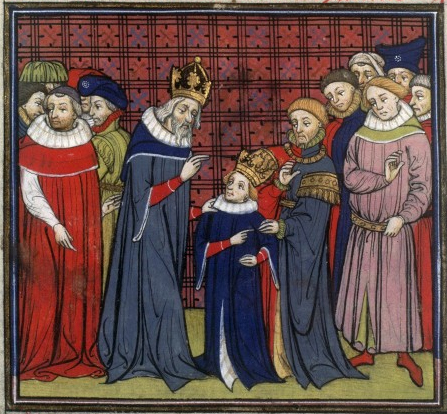
Has any of my three readers ever been struck by the utter randomness of medieval king-naming conventions? Take the French, for instance. First, we have Charlemagne. Although the "the great" suffix is a classic cliche, it isn't as bad as it could be because they actually incorporate it into his first name. Pretty nifty, if I dare say so myself. Next there's Louis the Pious. He sounds like a nice kind of guy. Then there's my personal favorite, Charles Martel. There are several reasons for this:
  1. This is a nice usage of foreign language - "Martel" is french for hammer, which brings me to....
  2. It's got a historical incident behind it - because of his crushing defeat of the Muslims at Tours, people likened him to the aforesaid tool, and finally,
  3. How many people have a metaphor in their name? Major points for such inovative creativity.
However, not so many kings were this lucky. Members of the hall of shame would include Pepin the Short, Charles the Bald, Louis the Stammerer and Charles the Fat. Wow, these poor guys' subjects must have had it in for them. How would you like to go down in history with a name like that? They obviously must have had high taxes.

I could go on and on about Viking names, but I think we'd all agree that they were pretty original in that department.


Moving on........I want to mention that my sister, Mary now has a blog. She's a lot funnier/more interesting than I am, so I'm risking losing my meager readership by mentioning it here. On top of that, she has this amazing ability to come up with an entertaining post on an unpromising topic. I wish I knew where she gets that from. Sigh.

Friday, February 26, 2010

Junto Update

Maddie and I, after discovering that the probability of our finishing a fiction Junto book was higher than that of a non-fiction one, have decided we're going to read another novel this time around. After much deliberation, we're going to do Quo Vadis by Henrik Sienkiewicz. In English, don't worry. ;-)

Here's what I know of the plot (the majority of which was found on the back of the book and Wikipedia....I know, I have great researching skills): A Roman patrician (aristocrat) falls in love with a Christian woman durring the Neronian persecutions. Apparently Peter & Paul make appearances too. I have no idea about anything else, except that there is a very strong pro-Christian theme. So all in all, from what I know, this book sounds marvelous! At least, I think so......the fact that it takes place in Rome grabbed me at the beginning. My friends have learned to dread the moment that Greece or Rome may come up in a conversation.......I have a slight obsession with the topic. Oh well. Thanks Maddie for putting up with me!


Well, I've gotta run, so sorry for a short post. Happy reading!

Friday, February 12, 2010

Jane Grey


Lady Jane Grey is a historical figure that - since I read her biography several years ago - I've always felt a connection with. Her academic and theological accomplishments, spiritual steadfastness, and willingness to accept whatever Providences befell her are things that I've always been drawn to and admire. Further than that, however, is that it's likely that we share the same birthday. Normally I wouldn't go bragging about something like that on my blog (who cares, anyways? ;-), but today that fact has been on my mind for a different reason - I'm the age she was when she died. Could I face the same gruesome death the way she did? The following is an account of the last moments of her life.
His [Guilford's, Jane's husband who was executed before her] carcass thrown into a cart, and his head in a cloth, he was brought to the chapel within the Tower, where the Lady Jane, whose lodging was in Partidge's house, did see his dead carcass taken out of the cart, as well as she did see him before alive on going to his death - a sight to her no less than death. By this time was there a scaffold made upon the green over against the White Tower, for the said Lady Jane to die upon.... The said lady, being nothing abashed....with a book in her hand whereon she prayed all the way till she came to the said scaffold.... First, when she mounted the said scaffold she said to the people standing thereabout: '
Good people, I am come hither to die, and by a law I am condemned to the same. The fact, indeed, against the queen's highness was unlawful, and the consenting thereunto by me: but touching the procurement and desire thereof by me or on my behalf, I do wash my hands thereof in innocency, before God, and the face of you, good Christian people, this day'
and therewith she wrung her hands, in which she had her book. And then, kneeling down, she turned to Feckenham [a priest who unsuccessfuly tried to convert her] saying, 'Shall I say this psalm?' And he said, 'Yea.' Then she said the psalm of Miserere mei Deus [Psalm 51], in English, in most devout manner, to the end. Then she stood up and gave...Mistress Tilney her gloves and handkerchief, and her book to master Bruges, the lieutenant's brother; forthwith she untied her gown. The hangman went to her to help her therewith; then she desired him to let her alone, and also with her other attire and neckerchief, giving to her a fair handkerchief to knit about her eyes.
Then the hangman kneeled down, and asked her forgiveness, whom she gave most willingly. Then he willed her to stand upon the straw: which doing, she saw the block. Then she said, 'I pray you dispatch me quickly.' Then she kneeled down, saying, 'Will you take it off before I lay me down?' and the hangman answered her, 'No, madame.' She tied the kerchief about her eyes; then feeling for the block said, 'What shall I do? Where is it?' One of the standers-by guiding her thereto, she laid her head down upon the block, and stretched forth her body and said: 'Lord, into thy hands I commend my spirit!' And so she ended.
Wow.

I don't know about you, but I find those words incredibly haunting. She starts off bravely, willing to face death in the face, but as soon as she can't see and is unable to find the block, the reality seems to set in and she panics. The painting at the beginning of this post portrays that instant of desperation. As if the story wasn't sufficient itself, the painting really makes you feel bad for her.


Enough morbidity. Anyways, I'd like to take this opportunity to recommend one of my favorite books EVER: Lady Jane Grey: The Nine Day Queen of England, by Faith Cook. It's a great read, and the story of this young woman's life could change your own. Do whatever it takes to get your hands on a copy of this book. It's that good.

Thursday, February 11, 2010

Villette - chapters 36-42

First of all, I would like to take this time to mention that this is the first time Maddie and I have finished reading a Junto book. **insert applause here** I'm very proud. ;-)

Well, these last chapters were sort of like a dream to me. Maybe it's the events in the book itself, or if not that, then my reading of it while watching TV with the fam is probably the culprit. :-)

A theme that is especially mentioned in these pages is the relationship between Protestantism and Romanism. Lucy's already been exposed to catholic attempts at converting her, and is especially so at the end of the book. Although she firmly remains Anglican, I was slightly disturbed by her attitude towards "the other side" in chapter 36 -
  • In the midst of a conversation with M. Paul, Lucy says,
    "I would not trouble your faith. You believe in God and Christ and the Bible, and so do I.”
    Inward groan.

    It's a rather generalized statement. On the surface, it looks like we believe in the same Deity and Bible, but the Catholic view of the two is so flawed that I find it hard to say they're the same. The basis for doctrinal and spiritual harmony between two beliefs is NOT a bare-bones adherence to basic Bible stories. It beats me how you can reconcile works-based and grace-based salvation and say they are basically the same thing.
  • Later on she says this about M. Paul:
    "I thought Romanism wrong, a great mixed image of gold and clay; but it seemed to me that this Romanist held the purer elements of his creed with an innocency of heart which God must love."
    The relatively innocent way a man thinks about his mangled view of God does not induce Him to overlook the aforesaid view.
  • Overall, Lucy's grievances against Roman Catholicism are not so much about salvation and theology proper but reckless clergy. Although Lucy states that she isn't a learned scholar, a child brought up in a Protestant home ought to have been able to discern that the really despicable thing about the Catholic church is not the wayward clergy but its unstable doctrinal foundation - the root of its other problems.
  • The final thing that bugs me is that Lucy allows herself to fall in love with someone of a different faith. As is clearly stated in the Bible, their union would be an unequally yoked one. A great lesson on the dire need for young people to commit themselves to guarding their hearts - in real life, if Lucy were indeed a born again Christian, her life would turn out to be a very sorrowful one: As Thomas Watson says in his book The Godly Man's Picture, a godly man is one who is concerned with making others godly; when a husband doesn't know Christ, his wife's heart will bleed for his soul.
Enough said. The following is a list of the (literary) things I liked and disliked about this book, in that order:
  • THE CHARACTERS! Mrs. Bretton, Lucy, Madame Beck and M. Paul will never cease to make me think deeply and laugh crazilly.
  • THE SETTING! I want to own a summer house in the vicinity of Villette when I grow up and get rich.
  • THE PSYCHOLOGY! The way Bronte brings you into the inner life of Lucy Snowe was absolutely magnificent. It really made me identify with her.
  • THE METAPHORS! Ahhhhhhhhhh.......all those allusions to the Bible, mythology, history and literature were brilliant.
Now begins the hall of shame.
  • The combinations of characters who got married. Lucy & M. Paul didn't get along! That was my one consolation with Graham & Polly - with them, it was at least plausible that they went well together. M. Paul is uncle, father, or (much) older brother - NOT husband - material! [cringe]
  • The ending. While I liked the idea of Lucy writing the book while waiting for M. Paul to return, what was Bronte thinking, leaving his fate unknown? Argh!
  • Lucy's past. (or lack thereof) I wish Bronte would have illuminated what was going on in Lucy's life that caused her to go to Villette, other than vaguely mentioning a berevement in the family. Dickens would have cleared that mystery up. ;-)
  • The aforesaid Protestantism-Catholicism issue.
All in all, while Villette isn't my favorite book, I enjoyed it immensly. Each book has a personality of its own, and just like people, you never forget the out-of-the-ordinary ones. Villette is definitely one of those.

Sunday, January 31, 2010

The Word in the Heart

Charles Spurgeon:
Notice that John not only mentions "the Word of God," but the Word of God "in you." The inspired Word must be received into a willing mind. How? The Book which lies there is to be pleaded here, in the inmost heart, by the work of the Holy Ghost upon the mind. All of this letter has to be translated into spirit and life. "The Word of God abideth in you" - that is, first to know it, - next to remember it and treasure it up in your heart. Following upon this, we must understand it, and learn the analogy of faith by comparing spiritual things with spiritual till we have learned the system of Divine truth, and are able to set it forth and plead for it. It is, next, to have the Word in your affections, to love it so that it is as honey or the droppings of the honeycomb to you. When this is the case, you must and shall overcome the wicked one. A man instructed in the Scriptures is like an armed knight, who when he goes among the throng inflicts many a wound, but suffers none, for he is locked up in steel.

Yes, but that is not all; it is not the Word of God in you alone, it is "the Word of God abideth in you." It is always there, it cannot be removed from you. If a man gets the Bible right into him, he is all right then, because he is full, and there is no room for evil. When you have filled a measure full of wheat, you have effectually shut the chaff out. Men go after novel and false doctrines because they do not really know the truth; for if the truth had gotten into them and filled them, they would not have room for these day-dreams. A man who truly knows the doctrines of grace is never removed from them: I have heard our opponents rave at what they call obstinacy. Once get the truth really into you, it will enter into the texture of your being, and nothing will get it out of you. It will also be your strength, by setting you watching against every evil thing. You will be on your guard if the Word abide in you, for it is written, "When thou goest it will keep thee." The Word of God will be to you a bulwark and a high tower, a castle of defense against the foe. Oh, see to it that the Word of God is in you, in your very soul, permeating your thoughts, and so operating upon your outward life, that all may know you to be a true Bible-Christian, for they perceive it in your words and deeds.
(A Good Start, pp. 107-109)


Friday, January 29, 2010

Villette - chapters 28-35

Several new developments have occurred in these pages, but they were rather visible afar off.
  • Graham and Polly like each other. While away on a trip, Polly was present when the mail came and was surprised to receive a letter herself from Graham. In it he apparently professed his admiration of her. Polly wrote back, thanking him and subtly made it known that the sentiments were reciprocated. There are difficulties, however. Paulina's father, Mr. Home, still thinks of and treats her as a child. How will he react when he hears of the secret "thing" between his daughter and Dr. Bretton? [On that note, I wonder what Ginevra will do ;-)]
  • M. Paul has a high regard for Lucy. Bronte's writing is rather murky on this point - I cant tell whether it's just friendship or love. (I'm hoping for the former because the man is over 40. Ew.) In these chapters you can see their relationship dramatically change: They go from regularly fighting in chapters 28 & 29 to living in mutual peace to - in chapter 35 - M. Paul's offering of his life-long friendship to Lucy.
  • We also learn about M.Paul's past. Commissioned to take a gift from Madame Beck to a house on the other side of town, Lucy meets up with an odd set of people upon arriving at her destination. The door is opened by an ancient and suspicious maid. The recipient of the gift is an old, malevolent looking lady. And what do you know, but the priest who tried to convert Lucy earlier on turns out to live there too! When a thunderstorm breaks out as Lucy is about to leave, the priest tells a story about two young people in love who were separated over financial differences. The girl, refusing to marry another, became a nun and died shortly afterwards. The young man, forgetting the wrongs done to him, took care of the girl's family after her father died. You guessed it - it's M. Paul. The grouchy old lady is his beloved Justine Marie's grandmother. Being the faithful lover that he was, he has never thought of another woman since.
The legend at the school is that a paranormal apparition - a nun, to be exact - haunts the garret of the building. Lucy has seen it twice - the first being back when Lucy had a crush on Graham. Distressed and lonely, she was sitting in the attic reading a letter of his when the nun appeared floating towards her. The second instance occurred when she was sitting in the alley alone in a contemplative mood. Graham, who got her to confide in him about it, assured Lucy that it was just her nerves doing weird things to her. And she believed it. Until now. M. Paul declares that he has seen it too, and while they talk in the alley, the nun appears! This must be his long lost love. I'm anxious to see what the apparition is all about!

One of the funniest chapters in the book is 29 - M. Paul and Lucy get into one of their trademark fights over a misunderstanding, namely that the day on which it happened was his anniversary of teaching at the school and everyone generally gave him a present, usually a bouquet. Lucy, however, goes against the grain and makes him (what I believe is) a chain for a pocket watch. She didn't get around to giving it to him at the right time, and he takes it as a total rejection. His reaction was downright comic. The whole section had me laughing but I'll close with this choice excerpt -

Owing to some little accidental movement—I think I dropped my thimble on the floor, and in stooping to regain it, hit the crown of my head against the sharp corner of my desk; which casualties (exasperating to me, by rights, if to anybody) naturally made a slight bustle. M. Paul became irritated, and dismissing his forced equanimity, and casting to the winds that dignity and self-control with which he never cared long to encumber himself, he broke forth into the strain best calculated to give him ease.

I don’t know how, in the progress of his discours, he had contrived to cross the Channel and land on British ground; but there I found him when I began to listen.

Casting a quick cynical glance round the room—a glance which scathed, or was intended to scathe, as it crossed me—he fell with fury upon “les Anglaises.”

Never have I heard English women handled as M. Paul that morning handled them. He spared nothing—neither their minds, morals, manners, nor personal appearance. I specially remember his abuse of their tall stature, their long necks, their thin arms, their slovenly dress, their pedantic education, their impious scepticism, their insufferable pride, their pretentious virtue; over which he ground his teeth malignantly, and looked as if, had he dared, he would have said singular things. Oh! he was spiteful, acrid, savage, and, as a natural consequence, detestably ugly.

“Little, wicked, venomous man!” thought I; “am I going to harass myself with fears of displeasing you, or hurting your feelings? No, indeed; you shall be indifferent to me as the shabbiest bouquet in your pyramid.”

I grieve to say I could not quite carry out this resolution. For some time the abuse of England and the English found and left me stolid. I bore it some fifteen minutes stoically enough; but this hissing cockatrice was determined to sting, and he said such things at last—fastening not only upon our women but upon our greatest names and best men, sullying the shield of Britannia and dabbling the Union Jack in mud—that I was stung. With vicious relish he brought up the most spicy current Continental historical falsehoods, than which nothing can be conceived more offensive. Zélie and the whole class became one grin of vindictive delight, for it is curious to discover how these clowns of Labassecour secretly hate England. At last, I struck a sharp stroke on my desk, opened my lips, and let loose this cry,—

“Vive l’Angleterre, l’Histoire et les Héros! A bas la France, la Fiction et les Faquins!” [Long live England, history and heroes! Down with France, fiction and fops!]

The class was struck of a heap. I suppose they thought me mad.

HAHA. I love you, Lucy Snowe.

Tuesday, January 19, 2010

Villette - chapters 24-27

In these chapters we are yet again re-acquainted with some characters from before - Paulina & her father.

Two months after her last letter from Graham, Lucy is invited back to the Bretton home with the promise of meeting old acquaintance. Upon arriving there, Lucy and Paulina - who is now 17 - meet again, and gradually a friendship forms. Paulina hasn't forgotten her friendship with Graham, and you can tell that she still has a thing for him. She isn't quite as obnoxious as I believed her to be; fortunately, she's grown into a gracious, amiable, and intelligent young woman.

What do you know, but Paulina and Ginevra are cousins.....and they despise each other. Ginevra's sentiments are similar to my first impressions of Polly; Paulina pretty much thinks of Ginevra the same way that Lucy does. Add to the mix that Graham seems to be showing some attention to Paulina, and boy, I really do pity Lucy for being forced to listen to Ginevra's diatribes about her cousin. Polly, on the other hand, is hurt by Ginevra's unsolicited opinions of Graham and love. Sounds like jealousy to me!

Picking up on this possible attraction between Graham and Paulina, Lucy realizes that she must give any hope of ever getting together with Graham. After discovering that Madame Beck has read his letters, Lucy carefully seals them in a bottle and buries them in the root of a tree in the alley behind the school. Fitting imagery for the burial that takes place in her heart.

Later on, Lucy attends a party at Paulina's hotel. Among the guests are Ginevra, Graham, and M. Paul Emmanuel - a fiery, opinionated teacher at Madame Beck's who is convinced that he has figured Lucy out, and takes on a strange guardian-ish air with her. One of my favorite episodes with him is in chapter 19 where he discovers Lucy at an art gallery gazing skeptically at a pretentious and rather indecent picture entitled Cleopatra. Scandalized that a young lady would have the gall to do such a thing, he marches Lucy into a nondescript corner, scolds her, and goes off to look at the picture himself. That, my readers, is M. Paul Emmanuel.

Returning to the party. While there, we encounter several revalations.
  • Graham still acts like he is still slightly under the spell of Ginevra. He talks to her, looks at her, and pays her too much attention for somebody "over" her.
  • Lucy realizes that Graham, although he thinks otherwise, does not understand nor take her seriously. And although she already had performed the aforesaid "burial," the revelation pains her deeply.
  • M. Paul Emmanuel acts singularly towards Lucy. Although he has a rough exterior, I believe deep down he genuinely likes her. Before they all go home, he is very attentive to Lucy and wants to make peace after a slight argument they had earlier on. I'm interested in seeing how significant he'll be in the rest of the story.
Something I enjoy and appreciate about this book is Bronte's numerous allusions to the Bible, history, literature and mythology. As in Jane Eyre, Villette is full of rich metaphors and similes which can really illuminate the story if you understand the stories behind them.


Wednesday, January 13, 2010

A belated birthday notice


January 9th was the 300th birthday of Sarah Edwards, one of my favorite women in history. She was married to Jonathan Edwards, who is considered to be the greatest American theologian. As they say, behind every great man there's a great woman, and this case is no exception! Witty, intelligent, discreet, gracious and godly, she was exactly the kind of wife the contemplative man needed. Obviously he noticed it too, writing his famous quote about her before they were married, and on his deathbed, he described their marriage as "an uncommon union." I love reading about their relationship.

If anyone's interested in learning more about Mrs. Edwards, I highly recommend
this book. As it's written by a secular author, there is a bit of a feminist spin to the writing, but it doesn't substantially detract from the book. Reading this book will always inspire me to imitate her godly character as a young girl and to one day be a wife that is a true helper to her husband. Without Sarah, Jonathan Edwards may not have been able to do for his country what he did.
Something amazing the aforesaid book mentions - by 1900, the Edwards family included 13 college presidents, a plethora of lawyers, deans of medical and law schools, 3 senators, a controller of the U.S. treasury, and a U.S. Vice President.

So, although I'm 4 days late in mentioning this, it's better late than never. These past three hundred years in America turned out the way they did because of this relatively unknown lady. Who knows which of us today will be this influential 300 years from now?

Monday, January 11, 2010

Villette - chapters 16-23

In these last chapters, the book has become so much better yet! There were some surprising developments and fantastic characters that you get to know better.

I was totally unprepared for the revelation that Dr. John is Graham Bretton. I had begun to wonder how he and his mother fit into the story when I came to this part of the book. Bronte does a phenomenal job of describing these two people - you feel as if you know them yourself.
  • Graham, alias Dr. John (his name is John Graham Bretton), is an empathetic, considerate, (usually) sensible, cheerful sort of guy. Ginevra is a total airhead for not appreciating him. He does, however, have his faults. Besides the glaring ill-judgment of being infatuated with an idiot, he can be selfish - he's kind to others, and appreciates it when they remind him of it. In spite of this, he is a very pleasing character to read about. He and Lucy begin to develop a good friendship...who knows what will come of it. :-)
  • Mrs. Bretton. This is the coolest woman ever. Despite her being middle aged, she, as Bronte puts it, still has the youthful air of a twenty year old. Not the midlife crisis immaturity; she's down to earth and her personality still retains the dignity of her age. I love reading the friendly banter that goes back and forth between her and Graham. She's hilariously sarcastic and has the best comebacks; she's rational and sensible; she has an incredibly thick skin. I would love to watch a chick flick with her - her running commentary on the sappiness of the movie would be priceless.
One of the pivotal moments of these chapters is where the three - Mrs. Bretton, Graham, and Lucy - go to a concert in which Ginevra performs. Before it begins, they're sitting and watching the girls onstage, and Ginevra sees Mrs. Bretton and makes fun of her with a friend. Graham is infuriated. As taken as he was with Ginevra, Graham loves his mother more, and at this point he has finally awoken to the flaws of the silly girl. He falls out of "love" with her - the rest of the night, he's in a mirthful mood. No more wistful sighing after Ginevra. (Boy, did I breathe a sigh of relief!) He keeps the incident to himself, not wanting to hurt his mother. It turns out, however, that she saw the whole thing herself and laughed it off. I love this woman.

Later on, after Lucy returns to school, she and Ginevra talk about the incident, and Lucy decides to have fun with her. Here's an abbreviated version of my favorite section -

"How is our well-beloved John? Do tell me about him. The poor man must be in a sad way. What did he say to my behaviour the other night? Wasn’t I cruel? ....Tell me what he said. I saw he was terribly cut up.”

“He said you looked as if at heart you were already Madame de Hamal.”

“Did he?” she cried with delight. “He noticed that? How charming! I thought he would be mad with jealousy......and how ever did you get him home?”

“How ever, indeed! Have you no pity on his poor mother and me? Fancy us holding him tight down in the carriage, and he raving between us, fit to drive everybody delirious. The very coachman went wrong, somehow, and we lost our way.”

“You don’t say so? You are laughing at me. Now, Lucy Snowe——”

“I assure you it is fact—and fact, also, that Dr. Bretton would not stay in the carriage. He broke from us, and would ride outside.”

“And afterwards?”

“Afterwards—when he did reach home—the scene transcends description....you will be able to conceive Dr. Graham Bretton rejecting his supper in the first instance—the chicken, the sweet-bread prepared for his refreshment, left on the table untouched. Then—but it is of no use dwelling at length on the harrowing details. Suffice it to say that never, in the most stormy fits and moments of his infancy, had his mother such work to tuck the sheets about him as she had that night.”

“He wouldn’t lie still?”

“He wouldn’t lie still. There it was. The sheets might be tucked in, but the thing was to keep them tucked in.”

“And what did he say?”

“Say! Can’t you imagine him demanding his divine Ginevra, anathematizing that demon De Hamal, raving about golden locks, blue eyes, white arms, glittering bracelets?”

.....to speak the truth, never had I been less dissatisfied with her than I was then. There was pleasure in thinking of the contrast between the reality and my description—to remember Dr. John enjoying the drive home, eating his supper with relish, and retiring to rest with Christian composure.

Ha!

So that's it for this week. I cant wait to read more!

Friday, January 1, 2010

2010

Happy New Year!

I can't believe it's been a decade since the "turn of the millennium." Amazing how quickly time goes by. There's something both sad and exciting about a new year - sadness because you can never get time back - all the good times you've had are mere memories now, and all the time you wasted will never be redeemed; it's exciting, however, because you have a whole year ahead of you filled with potentials - you can only guess and speculate on what's going to happen. Only God knows what's in store for us. Isn't that interesting how all the things in the future haven't happened yet, but they exist in God's mind?

Deep philosophical thoughts aside, I'm also surprised at how it's already been a year since I started this blog! I still vividly remember sitting in consternation in the living room, trying to figure out how to write a post. Ha. I hope I have many more years of blogging here yet!

Speaking of blogging, I'm really going to try at getting better with posting more often. Life gets so busy and at the end of the day the thought of using my mind and writing doesn't always appeal to me.........but I'm convinced it's a great way to organize my thoughts, build my skills at writing, and hopefully saying something worthwhile for others! Therefore, one of my New Year's resolutions is to be a better blogger. :-)

Since the topic of time is on my mind, I thought I'd leave you with this quote from Harvey Newcomb -

A very common fault lies in not estimating the value of a moment. This leads to the waste of immense portions of precious time. It is with time as with an estate. The old adage is, "Take care of the pennies, and the pounds will take care of themselves." So, if we take care of the moments, the hours will take care of themselves. Our whole life is made up of moments. A little calculation may startle those who carelessly trifle away small portions of time. Suppose you waste only ten minutes at a time, six times in a day; this will make an hour. This hour is subtracted from that portion of your time which might have been devoted to active employments. Sleep, refreshment, and personal duties, generally occupy at least one half of the twenty-four hours. You have, then, lost one-twelfth of the available portion of the day. Suppose you live to the age of seventy years. Take from this the first ten years of your life. From the sixty remaining years. you will have thrown away five years! These five years are taken from that portion of time which should have been employed in the cultivation of the mind, and in the practical duties of piety!

The common excuse for neglecting the improvement of the mind and the cultivation of personal piety, is the lack of time. Were you to employ one half of this time in reading, at the rate of twenty pages an hour, you would be able to read more than eighteen thousand pages, or sixty volumes, of three hundred pages each. If you employ the other half in devotional exercises, in addition to the time you would spend in this manner, upon the supposition that these five years are lost, what an influence will it have upon your personal piety! Or, if you spend the whole of it in the active duties of Christian benevolence, how much good may you accomplish! Think what you might do by employing five years in the undivided service of your Master.