Pages

Sunday, July 25, 2010

Convicting.

We have not known thee as we ought,
Nor learned thy wisdom, grace and pow'r;
The things of earth have filled our thought,
And trifles of the passing hour.
Lord, give us light thy truth to see,
And make us wise in knowing thee.

We have not feared thee as we ought,
Nor bowed beneath thine awful eye,
Nor guarded deed, and word, and thought,
Remembering that God was nigh.
Lord, give us faith to know thee near,
And grant the grace of holy fear.

We have not loved thee as we ought,
Nor cared that we are loved by thee;
Thy presence we have coldly sought,
And feebly longed thy face to see.
Lord, give a pure and loving heart
To feel and own the love thou art.

We have not served thee as we ought;
Alas! the duties left undone,
The work with little fervor wrought,
The battles lost, or scarcely won!
Lord, give the zeal, and give the might,
For thee to toil, for thee to fight.

When shall we know thee as we ought,
And fear, and love, and serve aright!
When shall we, out of trial brought,
Be perfect in the land of light!
Lord, may we day by day prepare
To see thy face, and serve thee there.

(Thomas Pollock)

Friday, July 23, 2010

On Antinomianism

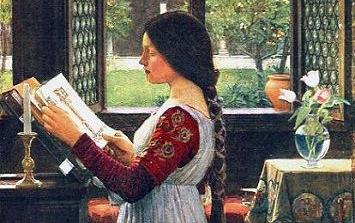
The Missal by John Waterhouse

Katherine Parr:
Only speaking of the Gospel makes not men good Christians, but good talkers, except [when] their facts and works agree with the same: so then their speech is good because their hearts are good. And even as much talk of the word of God, without practicing the same in our living, is evil and detestible in the sight of God, so it is a lamentable thing to hear how there are many in the world that do not well digest the reading of scripture, and do commend and praise ignorance, and say that much knowledge of God's word is the original of all dissension, schisms, and contention, and makes men haughty, proud, and presumptuous by reading of the same.

This manner of saying is no less than a plain blasphemy against the Holy Ghost. For the Spirit of God is the author of his word, and so the Holy Ghost is made the author of evil, which is a most great blasphemy and (as the scripture saith) "a sin that shall not be forgiven in this world, neither in the other to come" [Matt. 12:32]. It were all our parts and duties to procure and seek all the ways and means possible, to have more knowledge of God's word set forth abroad in the world, and not allow ignorance, and discommend knowledge of God's word, stopping the mouths of the unlearned with subtle and crafty persuasions of philosophy and sophistry, whereof comes no fruit, but a great perturbation of mind to the simple and ignorant, not knowing which way to turn them. For how is it not extreme wickedness to charge the holy, sanctified word of God with the offenses of man? To allege the scriptures to be perilous learning, because certain readers thereof fall into heresies?

(The Lamentation of a Sinner, chapter 10)
No doubt Katherine Parr had the Catholics of her day in mind as she wrote the above words, but they still stand relevant today. Sins have a nasty habit of recurring through the years: In the Middle Ages, the Roman church discouraged laymen from reading the Bible, asserting that only the allegedly well-trained clergy was capable of reading it correctly; today, Evangelicalism is infiltrated with the belief that "doctrine divides."

Monday, July 5, 2010

Summer Miscellanies

  1. A few days ago, I discovered the new stats tab on my blogger dashboard. Whoa, is it fun. In the past month, my brilliant blog had somewhere around 40 page views. And half were me. I know, TRAFFIC OVERLOAD.....
    There's 2 nice things about having an unread blog: a. You don't have to worry about what everyone thinks of what you say, and b. having a popularity complex is a problem you won't be dealing with for a while.....
  2. It's very difficult to get algae out of swimming pools.
  3. Maddie was over at my house on Saturday, and being the nerdy duo that we are, we went to Half Price Books. There, I spotted a couple of sets of books put out by one of the coolest publishers in the whole entire world. Every single book of theirs is a work of art. So are their prices. Ah well.
  4. The best summer project, a la Jonathan Edwards: "Resolved, to strive to my utmost every week to be brought higher in religion, and to a higher exercise of grace, than I was the week before."
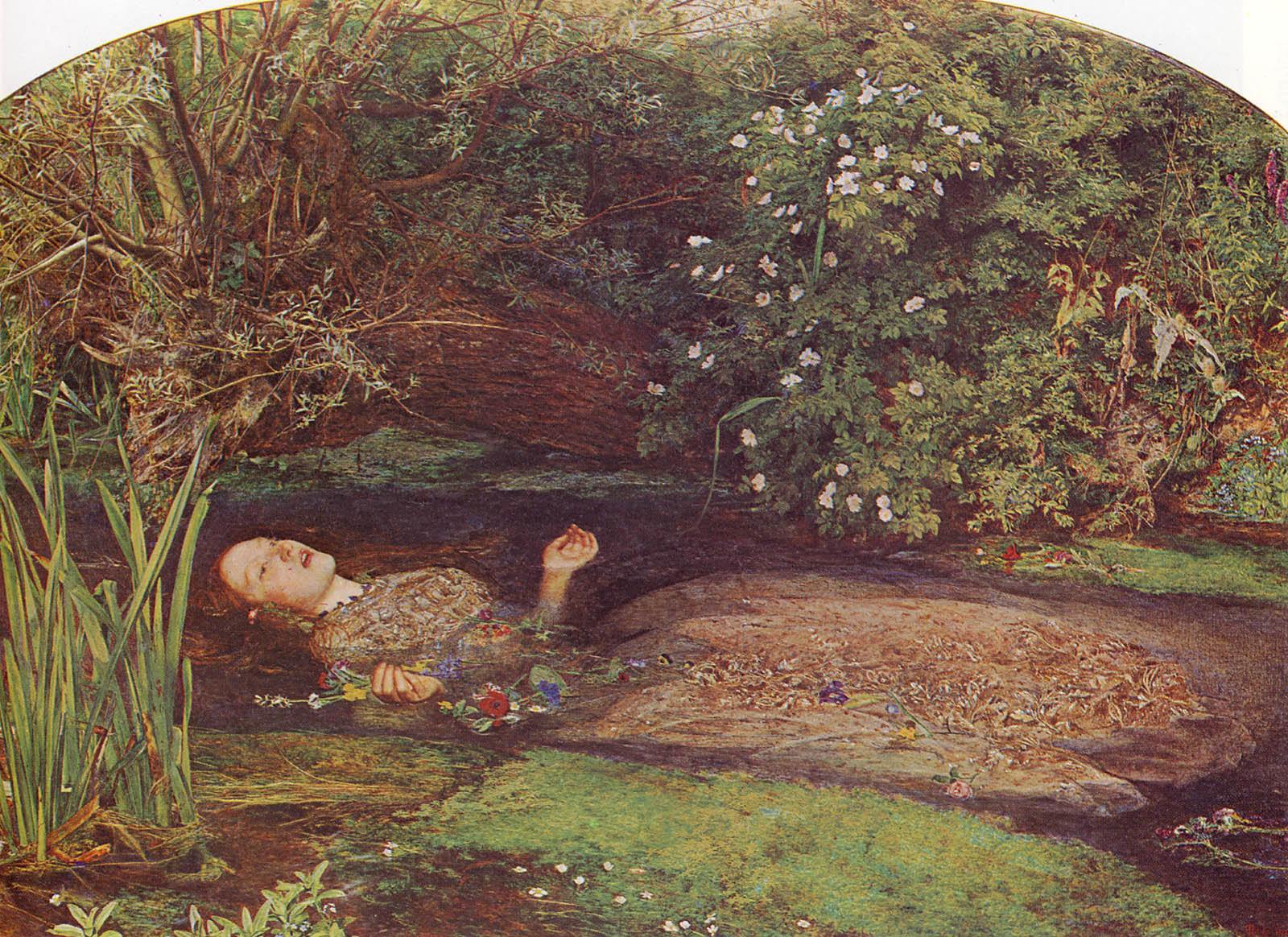
  5. Ok, only nerds like me will appreciate this one. The other day I came across an article about a painting I've often seen of Ophelia from Hamlet. Apparently, a lady found the exact location of the setting the artist painted. Wow.

Friday, July 2, 2010

Dante's Inferno

Through me the way to the infernal city,
Through me the way to eternal sadness,
Through me the way to the lost people.

Justice moved my supreme maker,
I was shaped by divine power,
By highest wisdom, and by primal love.

Before me, nothing was created
That is not eternal, and eternally I endure.
Abandon all hope, you that enter here.

(Canto 3, lines 1-9)

Imagine yourself wandering, lost, in a creepy forest and suddenly you happen upon Virgil, who takes you to a gateway that has these words hanging over it. Sound like a fun tourist trap? Ehhhh.....

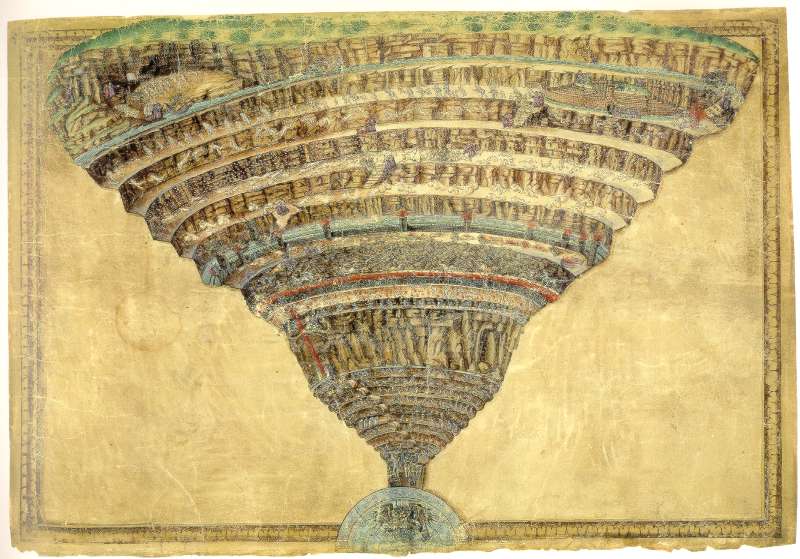
Botticelli's chart of Hell
Despite it's ominous first section, The Inferno quickly engaged my interest. I mean, who isn't fascinated by delightful things like demons pecking victims immersed in pitch or heretics entombed in blazing sarcophagi? Yeah, no one, I know. All joking profundity aside, I've often noticed that we humans have an interest in morbidity. Just like the Romans who flooded the Colosseum for the gladiator games and the medieval peasants enthralled by burning heretics, we modern, post-enlightenment, liberated-from-superstition people are still drawn to it. Ever noticed how popular horror flicks or ghost stories are?

The layout of Dante's hell makes the book a masterpiece in and of itself. The entire time I was reading The Inferno, I kept asking myself, "How did this guy come up with this stuff?!" According to the book, Hell is divided into two main sections and three types of sins - Upper Hell  (the sins of incontinence or lack of self control) and Nether Hell (the sins of violence and fraud).

In Upper Hell are found those characterized by lust, gluttony, stinginess & extravagance, and wrath. In case you were wondering, no, the punishments here aren't that creative. However, it does contain my favorite: the misers and the spendthrifts, who have been strategically placed in the same circle, are their  own punishment. All day long they bicker about the spending of eachother's money (or lack thereof) and throw stones at one another. Brilliant, Dante, brilliant.

The sins of violence come right after the aforesaid circle of the heretics and the people found there aren't quite what you would think of as particularly violent. There's the obvious murderers and suicides, but then there's those who are destructive towards God and the order He designed for His creation - profligates, usurers, blasphemers, etc. By far, however, the largest section of Hell is the sins of fraud. Dante includes a wide range of sins here, including flatterers, hypocrites, sorcerers, thieves, liars, and counselors of fraud.

When I got to the end of the story, I got a major case of heebie jeebies. In the last layer stands a gigantic Satan, whose three heads continually tear up the three most heinous traitors to their lords: Brutus, Cassius, and (dum dum dum!) Judas. Virgil and Dante end up having to climb down Satan's hairy body to get out of Hell. YEESH.

As Dante was a medieval Catholic, most people, as did myself, assume that his book is full of Catholicism. While it definitely is present, the more prominent force is Greek philosophy. For example, Dante got his inspiration for the organization of Hell from Aristotle, whose book on ethics laid out which sins were more destructive than others. Also, it's important to understand that the book is an allegory, like Pilgrim's Progress, and the punishments therin are images of how pernicious sin is in our lives. (Dante wasn't so concieted as to believe that he knew how the otherworld is set up :-) The biggest problem I had with Dante's assessment of which sin is worse than the other is in the beginning. In the first (and least serious) layer he places The Futile - those who knew about Christ but never did anything about it. The Bible clearly states that the sin of unbelief is one of the worst you can commit.

Overall, though, this book is definitely one of my favorites. It made me think. Although I'm unquestionably not a poetic type of person, I have a weekness for epics, and this is hands down one of the best. But I probably wouldn't have appreciated it as much if I didn't read the edition I did - Dorothy Sayers' translation was fun to read (it rhymed!) and her notes brought to my attention many things I never would have noticed. I highly reccomend it!

Wednesday, June 30, 2010

Dear blog, I haven't forgotten you...

....summer projects have been taking up my time. For the past 2 weeks or so we've been completely re-doing a back room in our house and it's finally starting to shape up. {Nota Bene - don't ever assume wallpaper simply glides off drywall. Reality is quite the opposite.....}

Dolce far Niente by John Waterhouse
I've been meaning to post more about The Warden but it's been difficult to get to. As this is the case, I think I'll just finish the book and post about it when I'm done. Is it just this book or do Anthony Trollope's stories have really sloooowww beginnings? I heard he and Dickens were similar writers, but so far, they seem incredibly different. Dickens usually grabs my attention right away.

Since summer's here, I've made a list of books I'd like to try reading before school starts up again. The Lord of the Rings, The Twelve Caesars, Five Cities That Ruled the World, Living for God's Glory, and Anne Dutton's Autobiography are some that I'm really excited about. Hopefully I'll be able to pull it off!

I hope yours is a relaxing summer!

Monday, June 14, 2010

The Warden? Oh yeah.....

I don't even remember when I said I was going to start reading this book.....maybe it's better that way. Boy am I pathetic. Oh well. I'm not too far into The Warden yet, but I was starting to stress out over how lazy I am on here so 2 chapters is better than nothing, right?

So far, the characters don't seem to be as brilliant as those in Bronte or Dickens. Maybe Villette has me addicted to 1st person narratives.

Anyways, so far, the character that stands out to me most is Dr. Grantly. Who is Dr. Grantly? Well, allow me to give you a short family run down of the main character - Septimus Harding. Mr. Harding, a widower, has 2 daughters - the elder is maried and the much younger one still at home. One of Mr. Harding's best friends is the bishop of the diocese, and the bishop's son, Dr. Grantly, is married to Mr. Harding's daughter. Dr. Grantly, that worthy man, is an archdeacon  in the Anglican church and his is an awe-inspiring, conservative, puritanical personality. The people of the town almost live in fear of him. But when he's at home with his wife, he miraculously reverts to being a normal person! It is his wife alone who seems to know his opinions, fears, observations, etc. To everyone else, he is rigid and cold. That dual personality cracks me up!

The aforesaid Septimus Harding is almost the opposite of Dr. Grantly. Everyone loves him - he's warm and friendly, chatty, and open minded. Simple things are what please him most, and he is especially fond of music. He's in charge of a charity hospital (it's really more like a senior home) which houses 12 elderly men. This institution was founded back in the middle ages and as time has gone by, it's become a very valuable bit of property. Mr. Harding, however, is generous and even lowerd his personal salary in order to give more to his men in Hiram's Hospital.

As I mentioned earlier, Mr. Harding's younger daughter, Eleanor, still lives at home. But maybe not for long. In the town, Barchester,  there is a young surgeon named John Bold, who admires Eleanor. As he is a friend of her father, John Bold often comes to visit them in the evening. Dr. Grantly, however, doesn't entirely approve of the match - John Bold is a zealous, progressive reformist.

Tension rises when Bold's new cause is a matter of how the funds are being spent at Hiram's Hospital. He shocks several in town when he comes to inquire after the Hospital's accounting. Dr. Grantly is scandalized and Mr. Harding is hurt. And I have no clue what happens next.

This quest for the holy grail, i.e. the truth of how the hospital is run, looks like it's the main conflict in the story. John Bold's eagerness for reform brings up a good question - which causes are worth our time campaigning for? There's an organization for everything from drinking milk to self-esteem to recycling to being nice to our pets. And which should we concern ourselves with? As Christians, our primary focus should be God's glory and advancing His kingdom. That cause will be here till the end of the earth, and whole lifetimes can be and are filled by doing so. It's so easy to become sidetracked by secular causes and forget about serving in the church, evangelism, discipleship, etc. 

So, where is the balance between the sacred and the mundane? I have two humble ideas. First, (obviously) we should take care that we never involve ourselves in something that would be contrary to what God says in His Word. Second, activities that could potentially point others to Christ seem to be better choices than others. For example, volunteering at a pregnancy center or supporting a child in a third world country might open doors to evangelism, whereas promoting ethanol usage is sort of a dead end. I'm not saying you should never do the latter kind of thing (the last thing I want to do is be legalistic!), but the former seems to have so much more potential for good you can do others.

Well, my mind has blessedly run out of things to say, so, until next week, adieu!

Tuesday, June 1, 2010

On the importance of miracles in the Gospels

Gresham Machen:
"It may certainly be admitted that if the New Testament narrative had no miracles in it, it would be far easier to believe. The more commonplace a story is, the easier it is to accept it as true. But commonplace narratives have little value. The New Testament without any narratives would be far easier to believe. But the trouble is, it would not be worth believing. Without the miracles the New Testament would contain an account of a holy man - not a perfect man, it is true, for He was led to make lofty claims to which He had no right - but a man at least far holier than the rest of men. But of what benefit would such a man, and the death of which marked His failure, be to us? The loftier be the example which Jesus set, the greater becomes our sorrow at our failure to attain to it; and the greater our hopelessness under the burden of sin. The sage of Nazareth may satisfy those who have never faced the problem of evil in their own lives; but to talk about an ideal to those who are under the thralldom of sin is a cruel mockery. Yet if Jesus was merely a man like the rest of men, then an ideal is all we have in Him. Far more is needed by a sinful world. It is small comfort to be told that there was goodness in the world, when what we need is goodness triumphant over over sin. But goodness triumphant over sin involves an entrance of the creative power of God, and that creative power of God is manifested by the miracles. Without the miracles, the New Testament might be easier to believe. But the thing that would be believed would be entirely different from that which presents itself to us now. Without the miracles, we should have a teacher; with the miracles we have a Savior."

(Christianity & Liberalism, pp. 103-104)

Monday, May 17, 2010

Hither and thither

John Waterhouse, A Grecian Flower Market
  1. I recently finished reading The Rule of St. Benedict. Whooaaaaaaa. I'm so glad I'm Protestant. Those monasteries are something else, let me tell ya. For instance, there was a no talking rule. Even if you had guests or a hoity toity bishop or something there, you'd be in deep yogurt* for speaking to them. (Obviously, these monasteries are for men....women wouldn't survive for 5 minutes with no chit chat) Also, you had to go to prayer services around 7 times a day. That meant waking up in the middle of the night. Yeesh. Usually I'm a pretty laid back person, but let me tell you, if I have a bad night's sleep, watch out! Yeah, so I'd never make it there.
  2. For all those who like the game Monopoly, you'll like it even more after reading this article. Surprising, huh?
  3. The school year's coming to a close. Remember when I mentioned in September that I made the mother of all reading lists? Well, that mamoth number of 24 books has now been whittled down to 15. Funny how that happens. What was I thinking? [shaking head]
  4. I love the paintings done by John Waterhouse. It's probably because his subjects are mostly of  legends or the myths of my beloved Classical world. Ahhh. Do any of my 3 readers have a favorite painter?
  5. Charles Spurgeon had a great morning devotional for today.
*"deep yogurt" is a phrase easily recognized by anyone who's taken an IEW course. Mr. Pudewa is awesome.

Sunday, May 16, 2010

The Road to Emmaus

"Behold, two of them were going that very day to a village named Emmaus, which was about seven miles from Jerusalem. And they were talking with each other about all these things which had taken place. While they were talking and discussing, Jesus Himself approached and began traveling with them. But their eyes were prevented from recognizing Him. And He said to them, "What are these words that you are exchanging with one another as you are walking?" And they stood still, looking sad. One of them, named Cleopas, answered and said to Him, "Are You the only one visiting Jerusalem and unaware of the things which have happened here in these days?" And He said to them, "What things?" And they said to Him, "The things about Jesus the Nazarene, who was a prophet mighty in deed and word in the sight of God and all the people, and how the chief priests and our rulers delivered Him to the sentence of death, and crucified Him. "But we were hoping that it was He who was going to redeem Israel. Indeed, besides all this, it is the third day since these things happened. "But also some women among us amazed us. When they were at the tomb early in the morning, and did not find His body, they came, saying that they had also seen a vision of angels who said that He was alive. "Some of those who were with us went to the tomb and found it just exactly as the women also had said; but Him they did not see." And He said to them, "O foolish men and slow of heart to believe in all that the prophets have spoken! "Was it not necessary for the Christ to suffer these things and to enter into His glory?" Then beginning with Moses and with all the prophets, He explained to them the things concerning Himself in all the Scriptures.
And they approached the village where they were going, and He acted as though He were going farther. But they urged Him, saying, "Stay with us, for it is getting toward evening, and the day is now nearly over." So He went in to stay with them. When He had reclined at the table with them, He took the bread and blessed it, and breaking it, He began giving it to them. Then their eyes were opened and they recognized Him; and He vanished from their sight. They said to one another, "Were not our hearts burning within us while He was speaking to us on the road, while He was explaining the Scriptures to us?" And they got up that very hour and returned to Jerusalem, and found gathered together the eleven and those who were with them, saying, "The Lord has really risen and has appeared to Simon." They began to relate their experiences on the road and how He was recognized by them in the breaking of the bread."
 Luke 24:13-35

Friday, May 14, 2010

My litterary hall of shame....or....The books I wish I didn't bother reading

THIS COULD BE YOU
In no particular order:
  1. The Mysteries of Udolpho. Ok, well, I'm sort of glad I read this one, because I kept hearing about it in Jane Austen and such. But boy, was this one a doozy. The character line-up includes a flighty heroine, a hero who eerily resembles John Willoughby in Sense & Sensibility, an aunt perpetually having a bad day, and the evil Count Montoni (he was really mean). It also boasts one of the sappiest plots ever. In parts where Mrs. Radcliffe intended for me to cry, I usually ended up laughing like a madwoman.
  2. Wuthering Heights. Perhaps one of my 3 readers has already noticed my disdain for this book. Cathy has too much of an attitude for me to sympathize with her, Heathcliff must be mad, and what is with the cousin marriage at the end? {shiver} Besides that, the tone of the book is so dreary that you feel depressed after each time you read it. And don't get me started on the plot...
  3. The Inheritance (Louisa May Alcott). This one makes Udolpho look serious. Also, if you've read Little Women, this would most definitely be the book Jo wrote. Features include archaic language complete with "thee" and "thou" usage and a predictable plot. Its one of the rare occasions when the movie is better than the book.
  4. Messenger. Lois Lowry is too out there. Unless you like books that don't make sense and end bleakly with conclusions that make you scratch your head.
  5. Gilgamesh. The ancient Sumerians had strange, strange minds. Nuff said.
I would have included Twilight here, but as I haven't had the horror of reading the series, I didn't think it'd be fair to include a book I haven't read. :D